Michel Mertens
PhD – Expert in shoulder rehabilitation & sports physiotherapy



Stay informed
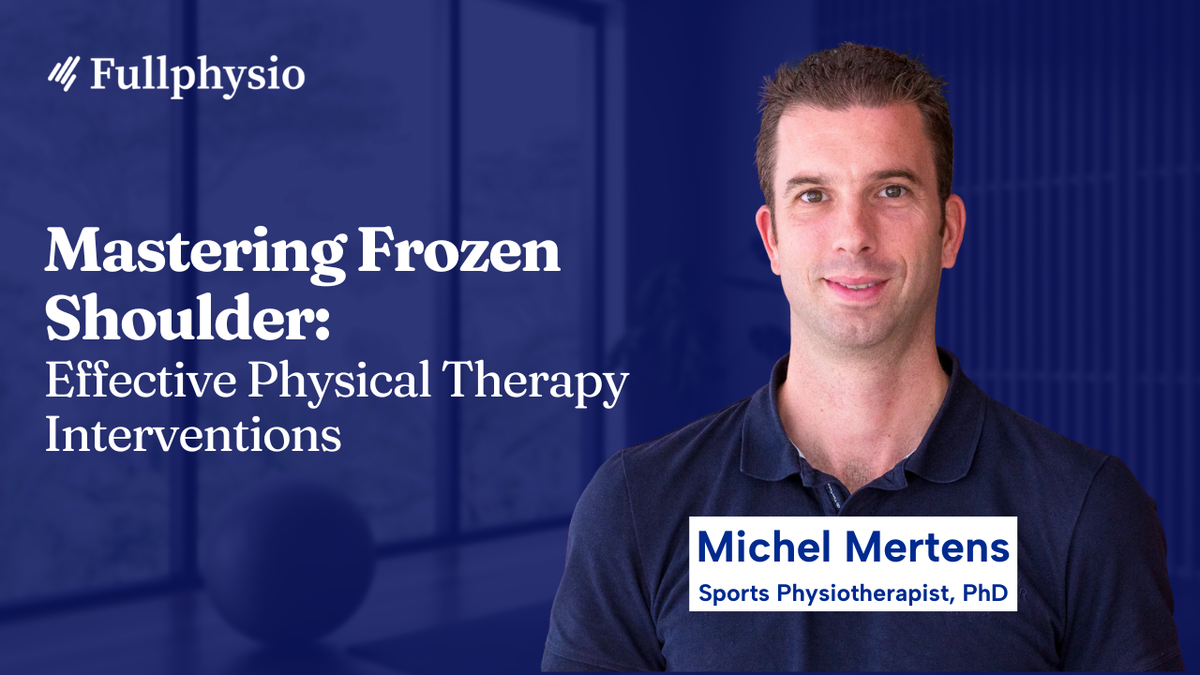
This article provides an in-depth update on current knowledge regarding frozen shoulder, a common condition that is still surrounded by many misconceptions in clinical practice. Most of the historically used clinical guidelines are over ten years old and are based on heterogeneous levels of evidence. However, in order to ensure standardized, consistent, and high-quality care, clinical recommendations should ideally be updated every three to five years. Recent evidence now calls for a substantial re-evaluation of several traditional management strategies.
Contrary to long-held beliefs, the most substantial improvements in shoulder function and range of motion do not occur during the later phases of the condition, but rather during the early ones. Historical models, largely based on prolonged immobilization during the painful phase, have likely contributed to this misconception. Current data show a rapid initial improvement followed by a progressive plateau, highlighting the importance of appropriately tailored interventions early in the disease process. Nevertheless, regardless of the therapeutic strategy implemented, it appears unrealistic to significantly shorten the overall duration of the condition. Treatment goals should therefore focus primarily on reducing the symptoms that matter most to the patient.
In clinical practice, it is often difficult to accurately classify patients according to the traditional phases of frozen shoulder (inflammatory, freezing, frozen, thawing). A more pragmatic approach is to reason in terms of irritability levels: high, moderate, or low. This framework allows clinicians to better guide treatment selection.
When irritability is high, priority should be given to patient education, explanation of prognosis, and guidance on how to remain active without exacerbating symptoms. Exercises should be performed within pain-free ranges, and certain adjunct interventions may be considered. At this point, passive mobilizations should be avoided, as stretching may stimulate myofibroblast activity and contribute to further movement restriction.
During the moderate irritability phase, physical therapy can be progressively intensified, with the gradual introduction of passive mobilizations while continuing therapeutic education. At this point, these techniques become appropriate, in contrast to the highly irritable phase.
When irritability is low, the focus shifts toward resistance-based exercises and restoration of function. If no meaningful improvement is observed despite well-conducted conservative management, surgical options may be discussed. The goal is to reintegrate strength, functional capacity, and confidence in shoulder use.
Current evidence confirms the overall value of manual therapy. Programs that include mobilizations are more effective than those without, leading to clinically meaningful improvements in shoulder abduction and disability. However, the specific type of mobilization, its direction, or its intensity does not appear to significantly influence outcomes. In contrast, isolated scapular mobilizations show no clear clinical benefit for pain, range of motion, or function.
Regarding exercise therapy, findings are robust: exercises improve pain, mobility, and function regardless of the specific program used. The inclusion of proprioceptive neuromuscular facilitation techniques appears particularly beneficial for improving function. Supervised exercise programs may be superior to home-based exercises alone, but this advantage diminishes when other interventions are added, suggesting that overall treatment quality and coherence are more important than the format itself.
Electrophysical modalities offer limited added value when combined with exercise, particularly for pain and range of motion. Shockwave therapy may provide short-term benefits for both pain and mobility, but without lasting effects. Laser therapy shows promising results for pain and disability at mid-term follow-up, whereas ultrasound therapy demonstrates limited usefulness, with no significant differences compared to placebo for mobility or function.
Several innovative approaches are gaining increasing interest. Mirror therapy, by addressing the mismatch between motor commands and sensory feedback, has demonstrated short-term benefits for pain, mobility, function, and quality of life when combined with conventional physical therapy. Virtual reality, by providing immediate and engaging feedback, has also shown clinically meaningful improvements in function and muscle strength.
Closed kinetic chain exercises represent another promising strategy. By enhancing proprioceptive feedback and global muscle activation, they provide added benefits for pain reduction and range of motion after several weeks of intervention.
Finally, therapeutic adherence remains a key determinant of outcomes. Simple strategies, such as daily text message reminders, can significantly improve adherence to home exercise programs, with a direct positive impact on shoulder range of motion.
Management of frozen shoulder should primarily be patient-centered and focused on individual functional priorities. By relying on irritability levels rather than theoretical stages that are often difficult to identify, physical therapists can better tailor their interventions and avoid inappropriate treatments, particularly passive mobilizations during highly irritable phases. The objective is not to shorten the condition itself, but to reduce its functional and symptomatic impact, using interventions supported by current evidence and a strong therapeutic alliance.
For more information and detailed explanations, as well as video demonstrations, we invite you to check out the complete Masterclass on Fullphysio. This content is only a summary of the original video.
Access to the Fullphysio app is opening soon.

Evidence-based knowledge and patient care, brought together in one platform for physiotherapists.
By subscribing, you agree to receive the Fullphysio newsletter. Every email carries an unsubscribe link. Privacy policy