Resources
Stay informed
Compression-Rotation Test

Contents
Test protocol
Context
Several injury mechanisms have been proposed to explain the pathogenesis of superior labrum anterior and posterior (SLAP) tears. Traumatic lesions may result from direct compressive loads, such as falling on an outstretched arm or onto the point of the shoulder, from direct traction injuries to the shoulder, or as a consequence of bracing for impact during a motor vehicle accident (Familiari et al., 2019).
SLAP lesions can also occur as a result of repetitive overhead activities in individuals involved in throwing sports or occupations involving repeated overhead loading. In these scenarios, SLAP tears often present with an insidious onset and progressively deep shoulder pain, particularly when the arm is in abduction and external rotation. Patients may also report a loss of strength and performance during the cocking phase of throwing (Brockmeyer et al., 2016).
To date, no single clinical test can definitively identify a SLAP lesion. Therefore, it is essential to adopt a combined approach, integrating multiple orthopedic tests and imaging to improve diagnostic accuracy. Large-scale prospective studies are still needed to determine the most reliable combination of tests.
Video of the Test
Execution
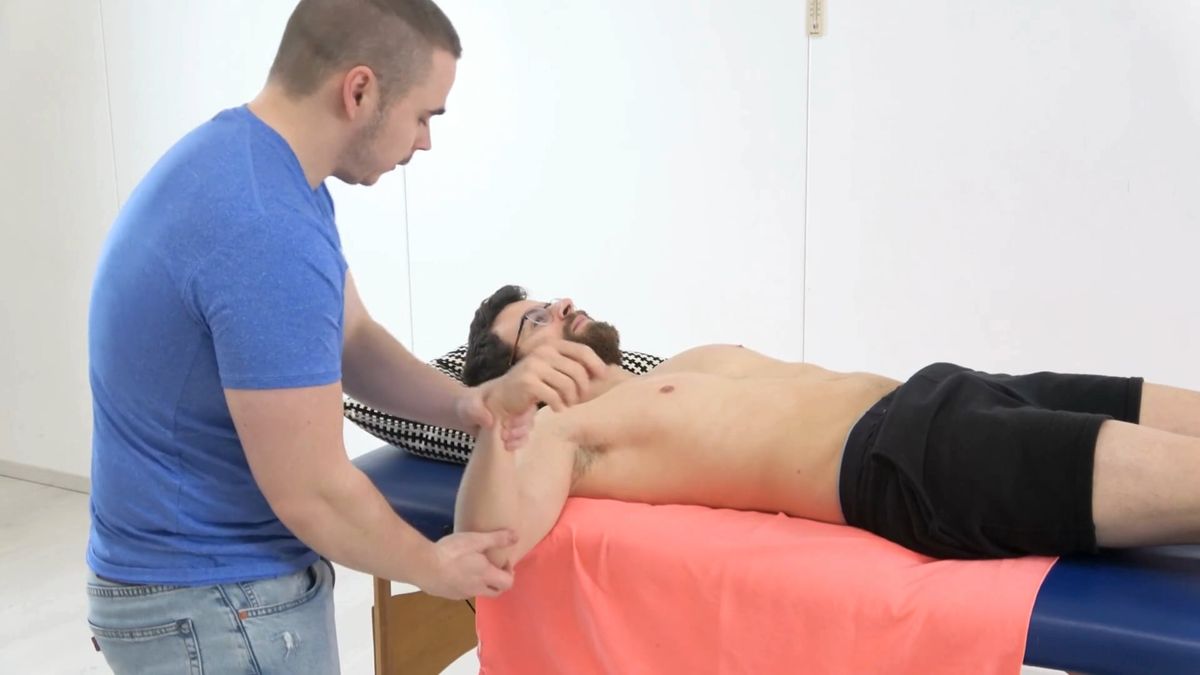
The patient is in a supine position while the examiner stands on the affected side. The patient’s arm is positioned in 90° abduction with the elbow flexed to 90°. The examiner then applies a compressive force along the humerus at the level of the elbow. Finally, the patient’s arm is passively rotated repeatedly into internal and external rotation, aiming to trap the torn labrum.
Positive result: painful catching or clicking, similar to the McMurray test for the knee.
Clinical Value
The Compression-Rotation test is used to diagnose SLAP lesions. Two studies have evaluated the diagnostic accuracy of this test:
- Gismervik et al. (2017) reported a sensitivity of 43% and a specificity of 89%. The positive likelihood ratio (LR+) was 3.91, indicating a moderate probability of a SLAP lesion when the test is positive, whereas the negative likelihood ratio (LR-) of 0.65 suggests that the absence of symptoms does not necessarily rule out the lesion.
- Somerville et al. (2017) found a lower sensitivity of 13.8%, but a high specificity of 92.6%. The LR+ was 1.8, indicating a slight increase in the probability of a SLAP lesion if the test is positive, and the LR- was 0.93, suggesting that the probability of having a SLAP lesion is only minimally reduced if the test is negative.
In summary, a positive test for a SLAP lesion moderately changes the post-test probability that the lesion is present.