Resources
Stay informed
Drop Arm Test (Codman Sign)
Contents
Test protocol
Context
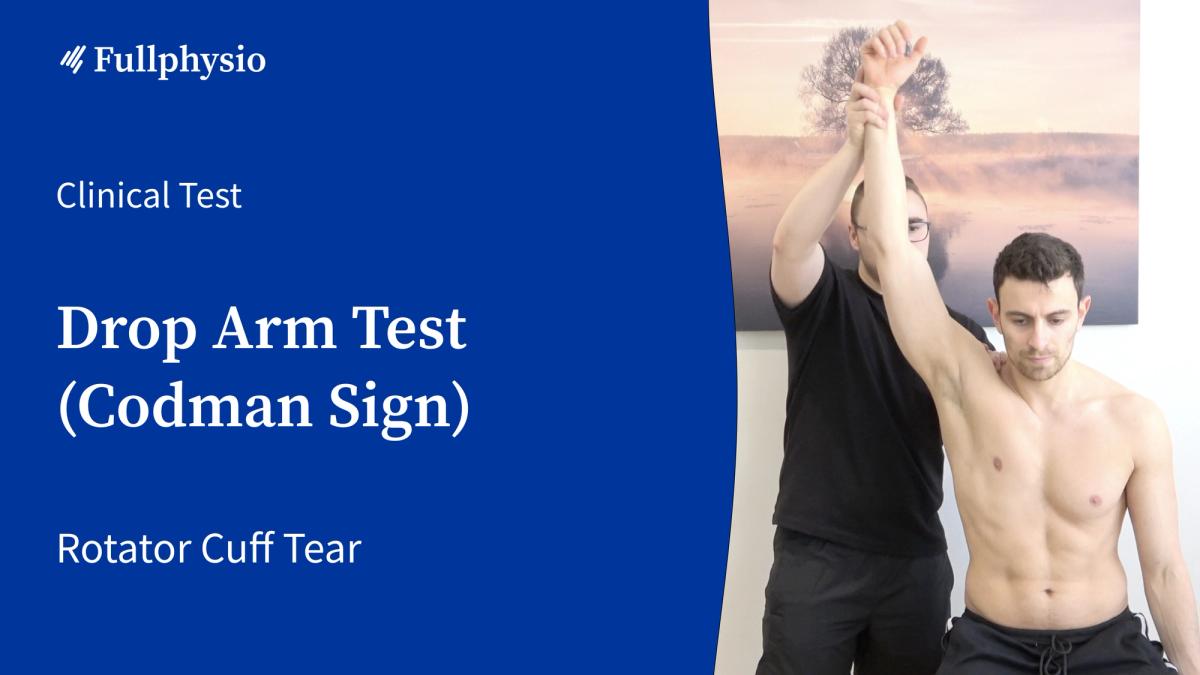
The Drop Arm Test is commonly used to help identify a rotator cuff tear.
Among patients with shoulder pain, rotator cuff tears are one of the most common causes of symptoms. Despite their high prevalence, diagnosing rotator cuff tears based solely on clinical examination remains challenging, and clinicians often rely on magnetic resonance imaging (MRI), a costly modality, to establish the diagnosis.
In 2024, a study by Gowda et al. showed that MRI is a preferred investigation and that its results are comparable to those of arthroscopy, which is considered the reference standard.
Although MRI has high sensitivity and specificity for diagnosing rotator cuff tears, it is well documented that such tears are also present in asymptomatic individuals. Therefore, imaging findings alone are not sufficient to establish the diagnosis of a clinically symptomatic rotator cuff tear.
As physical therapists, we often need to ensure that the tear is indeed the source of the patient’s pain and symptoms, and we then perform clinical maneuvers and tests.
Several maneuvers have been described to help diagnose a rotator cuff tear. Among these special tests is the Drop Arm Test.
This test shows high variability in its execution across studies, as it was not clearly described in its original source. In the literature, the “Drop Sign” is also often used to refer to a different test, performed with the elbow flexed and the shoulder in external rotation to assess the integrity of the infraspinatus. Here, we are referring to the “Drop Arm Sign,” also known as the “Codman Sign” (1934).
Video of the Test

Execution
This test is performed in the plane of abduction, with the patient’s arm passively positioned above 90° by the physical therapist; some authors describe it as maximal passive abduction (Penning et al., 2016). The patient is then asked to actively and slowly lower the arm in a controlled manner. The test is considered positive if the patient is unable to maintain the position or if the arm drops suddenly during lowering in the coronal plane (Hanchard et al., 2013; Codman, 1934).
Some authors (Chen et al., 2021) position the patient’s arm above 90° and simply ask them to briefly maintain the position. Others describe the test in the scapular plane, while some position the shoulder in external rotation, similar to a Full Can position.
In all cases, attention should be paid to any signs of pain, weakness, or inability to first hold a position above 90° of abduction and then control the lowering of the arm during the Drop Arm Test.
Clinical Value
We examined the clinical value of the Drop Arm Test. One of the main challenges was determining exactly which test was being referred to and how it was performed.
For the diagnosis of rotator cuff tears, Yazigi et al. (2021) reported that this test has a very low sensitivity of 16%, but a very high specificity of 98%, with specificity comparable to that reported for MRI and ultrasound in some studies (Lenza et al., 2013; Roy et al., 2015).
In the same year, Chen et al. (2021) reported that among the physical examination signs evaluated in their study, the Drop Arm Test demonstrated the highest specificity of 72.2% and the highest sensitivity of 51.9% for diagnosing full-thickness tears of the supraspinatus tendon.
Finally, Nicolao et al. (2022) conducted a study comparing the diagnostic values of specific shoulder tests with MRI for supraspinatus tendon tears in patients undergoing shoulder arthroscopy.
For any type of supraspinatus tear, the Drop Arm Test showed very low sensitivity of 0.19, but the same specificity as MRI at 0.98.
The authors stated that this test is valuable for confirming overall supraspinatus tears, with a positive predictive value of 0.97.
They also noted that one factor contributing to the high specificity of these clinical tests may be the possible association of supraspinatus and infraspinatus tears in the patients included in this study.
Overall, the conclusions converge on the same point: a cluster or combination of tests is always more useful than a single test for guiding the diagnosis.
Bibliography
Anauate Nicolao, Fabio, Joao Alberto Yazigi Junior, Fabio Teruo Matsunaga, Nicola Archetti Netto, Joao Carlos Belloti, et Marcel Jun Sugawara Tamaoki. « Comparing shoulder maneuvers to magnetic resonance imaging and arthroscopic findings in patients with supraspinatus tears ». World Journal of Orthopedics 13, no 1 (18 janvier 2022): 102‑11.
Chen, Si, Yuanyuan Shi, Pan Xue, et Xue Chen. « Application Value of Magnetic Resonance Arthrography of the Shoulder in Nursing and Diagnosis of Patients with Shoulder Joint Injury ». Journal of Healthcare Engineering 2021 (2021): 3051578.
Codman, EA. The Shoulder: Rupture of the Supraspinatus Tendon and Other Lesions In or About the Subacromial Bursa. Boston Medical Library, 1934.
Gowda, Chiranjeevi S., Kiyana Mirza, et Dev A. Galagali. « Rotator Cuff Tears: Correlation Between Clinical Examination, Magnetic Resonance Imaging and Arthroscopy ». Cureus 16, no 3 (mars 2024): e56065.
Hanchard, Nigel C. A., Mário Lenza, Helen H. G. Handoll, et Yemisi Takwoingi. « Physical Tests for Shoulder Impingements and Local Lesions of Bursa, Tendon or Labrum That May Accompany Impingement ». The Cochrane Database of Systematic Reviews 2013, no 4 (30 avril 2013): CD007427.
Penning, L. I. F., R. A. De Bie, P. Leffers, R. E. Weijers, et G. H. I. M. Walenkamp. « Empty Can and Drop Arm Tests for Cuff Rupture : Improved Specificity after Subacromial Injection ». Acta Orthopaedica Belgica 82, no 2 (août 2016): 166‑73.
Yazigi Junior, João Alberto, Fábio Anauate Nicolao, Fábio Teruo Matsunaga, Nicola Archetti Netto, João Carlos Belloti, et Marcel Jun Sugawara Tamaoki. « Supraspinatus Tears: Predictability of Magnetic Resonance Imaging Findings Based on Clinical Examination ». Journal of Shoulder and Elbow Surgery 30, no 8 (août 2021): 1834‑43.