Resources
Stay informed
Neck Tornado Test
Contents
Test protocol
Context
The Neck Tornado Test or Choi’s Test can be used in the diagnosis of cervical radiculopathy.
Cervical radiculopathy is a term used to describe pain radiating into the arm that corresponds to the dermatome of a cervical nerve root (Thoomes et al., 2018). It may be related to compression and/or irritation of one or more cervical nerve roots, particularly C6 and C7, which are the most commonly affected levels (Radhakrishnan et al., 1994; Park et al., 2017; Thoomes et al., 2018; Slejser-Kioehorst et al., 2021). In most cases, neck pain involving neural tissue does not represent a major immediate concern for the patient and is effectively managed with conservative treatment. However, nerve function may sometimes deteriorate, potentially leading to irreversible long-term consequences if these conditions are not identified early.
When discussing cervical radiculopathy, the first test that often comes to mind is the Spurling Test, considered the gold standard for diagnosing this type of condition (De Luigi and Fitzpatrick, 2011; Slejser-Kioehorst et al., 2021). It is a powerful test, typically indicated when cervical radiculopathy has not been clearly identified through other elements of the clinical examination.
However, although it is a highly specific test whose validity has been demonstrated over the years in the literature, it has low to moderate sensitivity (Malanga, 1997; De Luigi and Fitzpatrick, 2011; Park et al., 2017; Slejser-Kioehorst et al., 2021).
This low sensitivity is thought to be due to the fact that the Spurling Test is designed to exacerbate nerve root compression by reducing the size of the foramen along a single axis where the compressive force is applied. However, it is nearly impossible to know the exact axis in which the root compression occurs, and thus to determine the optimal direction for applying the compression force (Park et al., 2017).
To address this issue, Park et al. introduced a new symptom provocation test in 2017 in which compressive force is applied across a 180° arc: the Neck Tornado Test.
Video of the Test
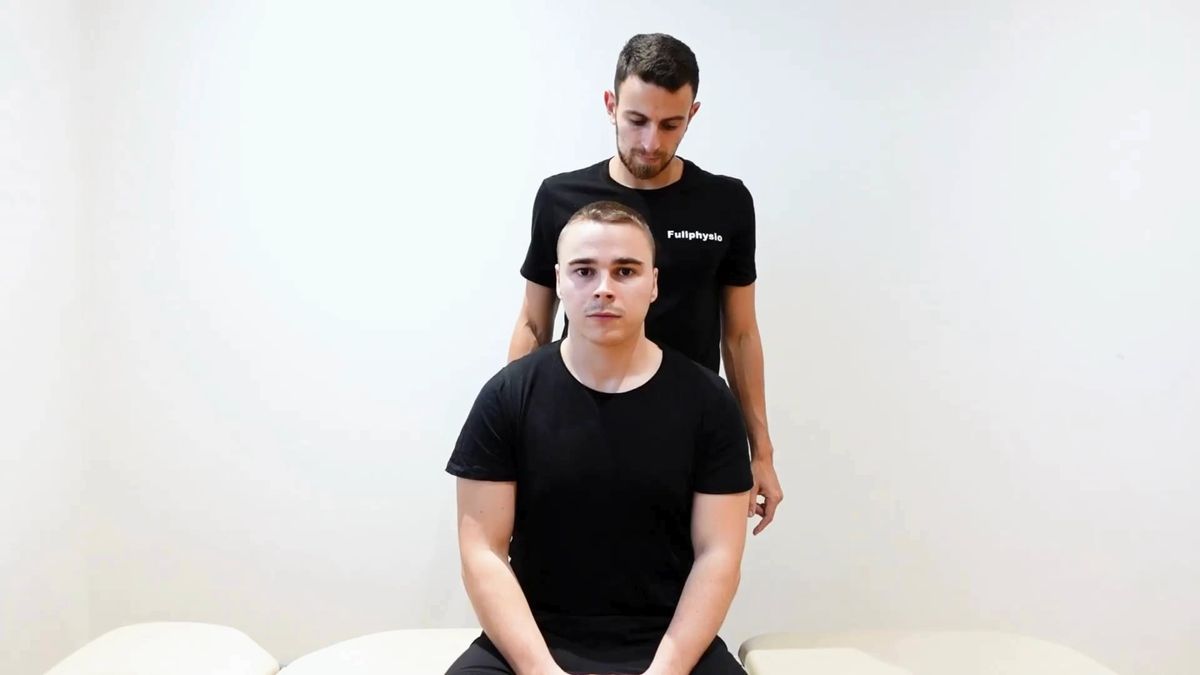
Execution
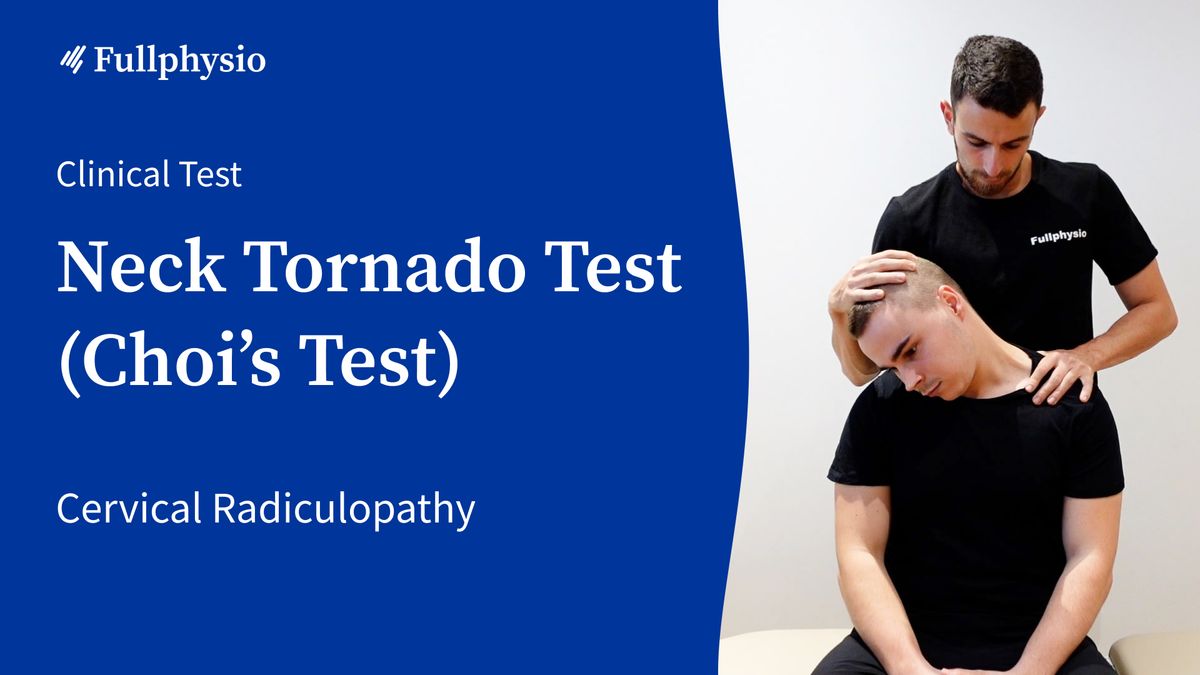
To perform this test, the patient is seated while the physical therapist stands behind them. The therapist stabilizes the patient’s body with one hand and applies gentle vertical pressure to the top of the head with the other hand while the neck remains relaxed. This pressure is maintained on the cervical spine throughout the whole test. Neck rotation is then initiated. To do this, the patient’s neck is flexed as far as possible from the vertical axis, then rotated toward the painful side, progressing into full lateral tilt and full 180° extension, following a tornadic pattern.
The test is considered positive if it reproduces or worsens radicular pain or tingling in the ipsilateral shoulder or upper limb (Park et al., 2017).
Clinical Value
The Neck Tornado Test is considered a simple and effective screening tool, with a sensitivity of 85% and a specificity of 87%.
Its diagnostic accuracy therefore appears to be higher than that of the Spurling Test.
However, Park et al. caution that further studies are needed to assess its reliability and reproducibility (Park et al., 2017).
Bibliography
De Luigi, A. J., & Fitzpatrick, K. F. (2011). Physical examination in radiculopathy. Physical Medicine and Rehabilitation Clinics of North America, 22(1), 7‑40
Malanga, G. A. « The Diagnosis and Treatment of Cervical Radiculopathy ». Medicine and Science in Sports and Exercise 29, no 7 Suppl (juillet 1997): S236-245
Park, Juyeon, Woo Young Park, Seungbae Hong, Jiwon An, Jae Chul Koh, Youn-Woo Lee, Yong Chan Kim, et Jong Bum Choi. « Diagnostic Accuracy of the Neck Tornado Test as a New Screening Test in Cervical Radiculopathy ». International Journal of Medical Sciences 14, no 7 (2017): 662‑67
Radhakrishnan, K., W. J. Litchy, W. M. O’Fallon, et L. T. Kurland. « Epidemiology of Cervical Radiculopathy. A Population-Based Study from Rochester, Minnesota, 1976 through 1990 ». Brain: A Journal of Neurology 117 ( Pt 2) (avril 1994): 325‑35
Rubinstein, Sidney M., Jan J. M. Pool, Maurits W. van Tulder, Ingrid I. Riphagen, et Henrica C. W. de Vet. « A Systematic Review of the Diagnostic Accuracy of Provocative Tests of the Neck for Diagnosing Cervical Radiculopathy ». European Spine Journal: Official Publication of the European Spine Society, the European Spinal Deformity Society, and the European Section of the Cervical Spine Research Society 16, no 3 (mars 2007): 307‑19
Slejser-Kioehorst, M. L. S., Coppieters, M. W., Epping, R., Rooker, S., Verhagen, A. P., & Scholten-Peeters, G. G. M. (2021). Diagnostic accuracy of patient interview items and clinical tests for cervical radiculopathy. Physiotherapy, 111, 74‑82.
Thoomes, Erik J., Sarita van Geest, Danielle A. van der Windt, Deborah Falla, Arianne P. Verhagen, Bart W. Koes, Marloes Thoomes-de Graaf, Barbara Kuijper, Wendy G. M. Scholten-Peeters, et Carmen L. Vleggeert-Lankamp. « Value of Physical Tests in Diagnosing Cervical Radiculopathy: A Systematic Review ». The Spine Journal: Official Journal of the North American Spine Society 18, no 1 (janvier 2018): 179‑89
Wainner, Robert S., Julie M. Fritz, James J. Irrgang, Michael L. Boninger, Anthony Delitto, et Stephen Allison. « Reliability and Diagnostic Accuracy of the Clinical Examination and Patient Self-Report Measures for Cervical Radiculopathy ». Spine 28, no 1 (1 janvier 2003): 52‑62.