Resources
Stay informed
Posterior Shoulder Endurance Test (PSET)
Contents
Test protocol
Context
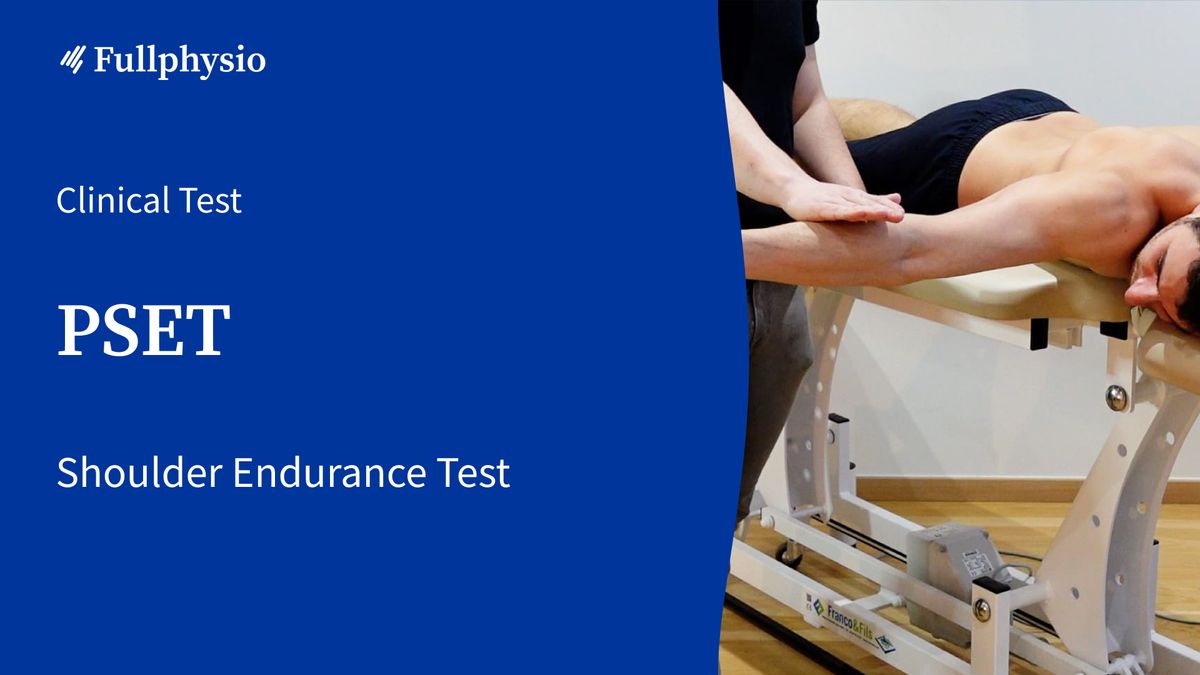
The Posterior Shoulder Endurance Test (PSET) measures the endurance of the posterior shoulder muscles in the open kinetic chain (Declève, 2021).
The endurance of the posterior shoulder muscles in overhead sports athletes is not routinely assessed (Moore et al., 2013). Yet we know that muscle endurance is crucial for maintaining muscle function across numerous throws and throughout long seasons.
Muscle fatigue alters muscle activation patterns, torques, and kinematics, which can lead to injury (Declève et al., 2021). Local ischemia created by a fatigued muscle or a compressed tendon can, over time, cause structural weakness. This weakness can lead to a local control deficit and, in the case of a rotator cuff tendon, an inability to control the humeral head during shoulder elevation (Evans et al., 2018). Arm fatigue has indeed been identified as a risk factor for shoulder and elbow pain in young baseball pitchers (Lyman et al., 2001).
The posterior shoulder muscles play a key role in maintaining shoulder function during the throwing motion. Due to the high deceleration forces involved, particular attention has been paid to these muscles (Moore et al., 2013).
To determine whether an athlete is ready to return to shoulder sports, the choice of testing battery depends on the athlete’s profile (overhead athletes / throwers or contact sports) and, in the latter case, on the direction of the instability (anterior vs. posterior), as illustrated in the mapping proposed by Olds et al. (2024).
In addition to the athlete’s overall profile, the specific selection of return-to-sport tests should also be tailored to the sport in question. Here is the battery of tests recommended by Tooth et al. (2022), broken down by sport:
Video of the Test
Execution
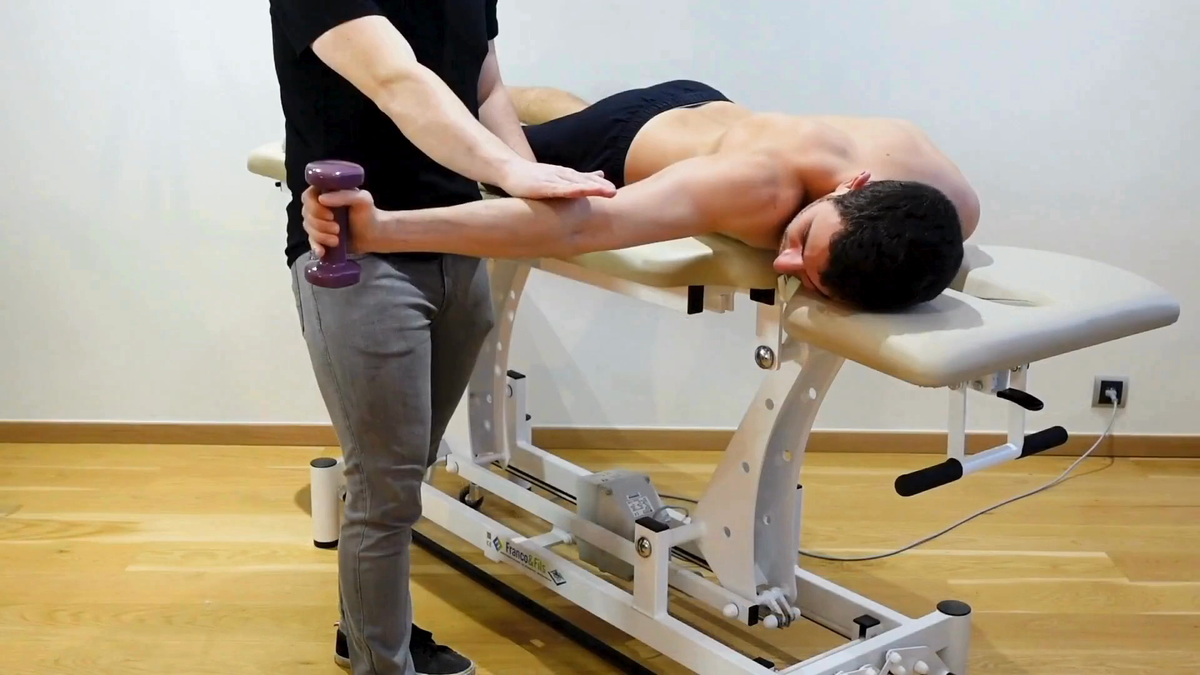
To perform the PSET, the participant is in a prone position with the arm to be tested hanging off the edge of the table, holding a weight equal to 2% of their body weight. They perform 90° of horizontal abduction with the arm extended and the shoulder in lateral rotation, then hold the position for one second before returning to the starting position. Movements are performed at a cadence of 30 beats per minute. Repetitions are performed until the participant is fatigued. The test stops when the participant is unable to hold the arm in the end position for the required duration, compensates by elevating the entire upper trunk, or reports that they are unable to continue (Moore et al., 2013).
These criteria were reviewed in greater detail by Powell et al. in their 2021 study. The authors proposed the following stopping criteria:
- inability to achieve / maintain the arm at 90° of horizontal abduction;
- inability to maintain the metronome rhythm;
- presence of compensatory scapular movements;
- inability to maintain lateral rotation of the glenohumeral joint;
- use of trunk rotation to reach the end position;
- use of the lower limbs to achieve horizontal abduction;
- untested arm gripping the table;
- inability to continue (Powell et al., 2021).
Clinical Value
In athletes, this test can be performed during the sports season or in the preseason. In the event of injury, the physical therapist can compare results with those obtained by the athlete before the injury. One of the return-to-sport goals may be to achieve more or less the same results. In cases where the physical therapist does not have pre-injury results, normative data can be used, although these are still being developed according to gender and sport.
The test has proven reliable with good test-retest values (ICC = 0.85), but its validity remains unknown (Declève, 2021). Powell et al. considered that an intra-rater MDC of 6 repetitions was necessary to indicate a meaningful change. However, these data should be interpreted with caution, as further studies are needed to establish recommendations (Powell et al., 2021).
This test has been recognized as a valuable tool for assessing posterior shoulder muscle endurance and may be particularly relevant for sports, such as swimming, where the posterior shoulder muscles are heavily solicited. One limitation raised is that following this test, the shoulder is too fatigued to perform further assessments (Tooth et al., 2024).
Isometric Variant
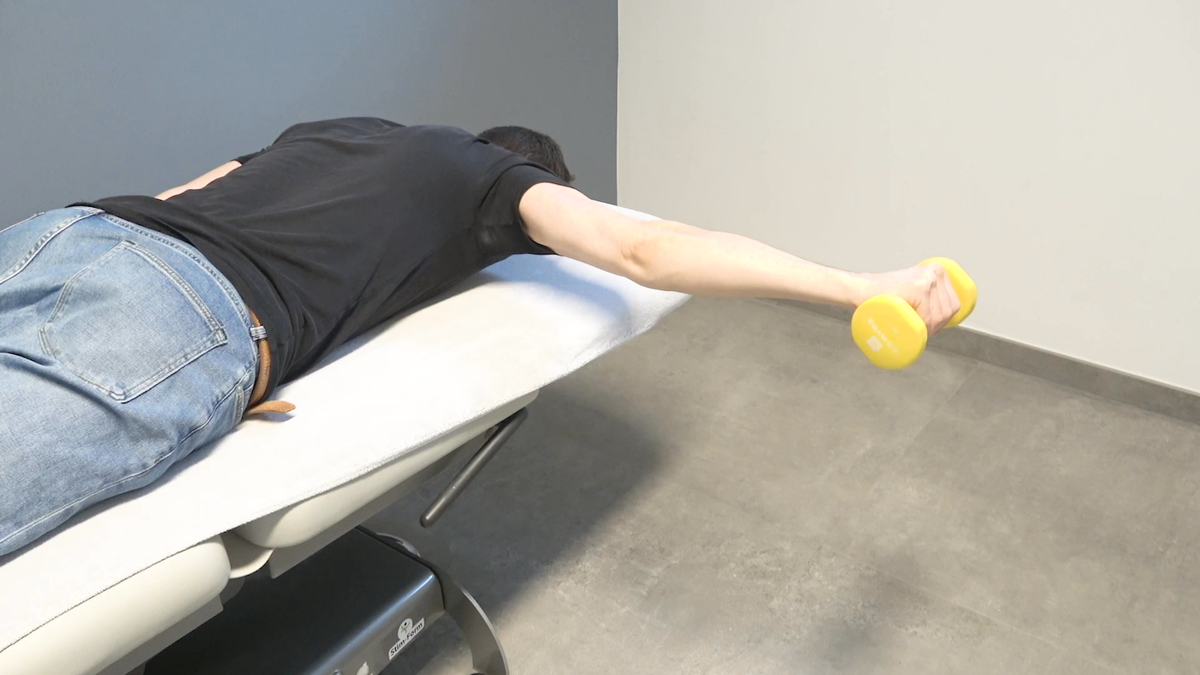
The PSET can also be performed in an isometric form, allowing assessment of the posterior shoulder muscles’ ability to sustain a prolonged contraction. In this version, the patient is placed in a prone position with the arm positioned at 90° of horizontal abduction and external rotation, with the elbow extended. A light load is held in the hand (often 2% to 3% of body weight, or a standardized load according to the protocol), and the patient must hold the arm aligned with the trunk, parallel to the floor, for as long as possible. The test is stopped when the patient is no longer able to maintain the position or when the arm drops below the horizontal level.
Studies that have analyzed this test show that it primarily engages the posterior deltoid, infraspinatus, and scapular stabilizers, with progressive muscle fatigue observed on EMG throughout the hold (Evans et al., 2018). Furthermore, the PSET demonstrates good test-retest reliability (ICC ≈ 0.77-0.85) and can distinguish between subjects presenting with shoulder pain (Evans et al., 2021). In asymptomatic subjects, more precise endurance times have been reported at around 60 to 90 seconds in men and 45 to 75 seconds in women, while shorter durations may be observed in patients presenting with shoulder dysfunction (Evans et al., 2021).
Bibliography
Declève, Philippe. « Analytical and Functional Assessment of the Athlete’s Shoulder ». Dissertation, Ghent University, 2021.
Declève, Ph.; Van Cant, J.; Attar, T.; Urbain, E.; Marcel, M.; Borms, D.; Cools, Ann M. (2021). The shoulder endurance test (SET): A reliability and validity and comparison study on healthy overhead athletes and sedentary adults. Physical Therapy in Sport, 47(), 201–207.
Evans, Neil A.; Dressler, Emily; Uhl, Tim (2018). An electromyography study of muscular endurance during the posterior shoulder endurance test. Journal of Electromyography and Kinesiology, 41(), 132–138.
Lyman, S., G. S. Fleisig, J. W. Waterbor, E. M. Funkhouser, L. Pulley, J. R. Andrews, E. D. Osinski, et J. M. Roseman. « Longitudinal Study of Elbow and Shoulder Pain in Youth Baseball Pitchers ». Medicine and Science in Sports and Exercise 33, no 11 (novembre 2001): 1803‑10.
Moore, Stephanie D., Tim L. Uhl, et W. Ben Kibler. « Improvements in Shoulder Endurance Following a Baseball-Specific Strengthening Program in High School Baseball Players ». Sports Health 5, no 3 (mai 2013): 233‑38.
Powell, A., Levy, E., Heneghan, N. R., & Horsley, I. (2021). Intra-rater reliability, inter-rater reliability and minimal detectable change of the posterior shoulder endurance test in elite athletes. Physical Therapy in Sport, 49, 62–67.
Tooth, C., Schwartz, C., Ann, C., Croisier, J.-L., Gofflot, A., Stephen, B., & Forthomme, B. (2024). Upper limb functional testing in athletes : A Delphi study. Shoulder & Elbow, 16(1 Suppl), 89‑99.