Resources
Stay informed
Radial Synergy Test
Contents
Test protocol
Context
We will discuss here the Radial Synergy Test, which can be used in the diagnosis of De Quervain tenosynovitis.
De Quervain tenosynovitis is a common cause of wrist pain, with a reported incidence of 0.94 per 1,000 people per year in the working population, with a higher incidence in women than in men (Wolf et al., 2009; Wu et al., 2018; Lee et al., 2023).
De Quervain tenosynovitis affects the synovial sheaths of the abductor pollicis longus (APL) and extensor pollicis brevis (EPB) tendons where they pass through a fibroosseous tunnel at the first dorsal compartment of the wrist. Although the exact etiology is not well understood today, this condition may be due to repetitive and sustained tension on these tendons as they pass under a thickened and swollen extensor retinaculum (Goel and Abdzug, 2015; Som et al., 2022).
The diagnosis is made clinically on the basis of patient history and physical examination, and tests have demonstrated their value, such as the Finkelstein Test and the Eichhoff Test, which are commonly used maneuvers (Ilias et al., 2007; Adams et al., 2015; Lee et al., 2023).
However, there are many limitations in these tests, and even some confusion regarding how they are supposed to be performed (Elliott, 1992; Cheimonidou et al., 2019). Their specificity has also been called into question due to their predisposition to provoke pain in asymptomatic patients, and more specific maneuvers would be of interest to establish a diagnosis (Lee et al., 2023).
Using the principle of synergy, the Radial Synergy Test would leverage the isometric contraction of the first dorsal compartment generated by resistance to little finger abduction. The authors tested this by first performing the Radial Synergy Test on themselves while using EMG to measure the activity of the EPB and APL muscles. This confirmed active contractions of both muscles in forearm pronation and supination (Lee et al., 2023).
Video of the Test
Execution
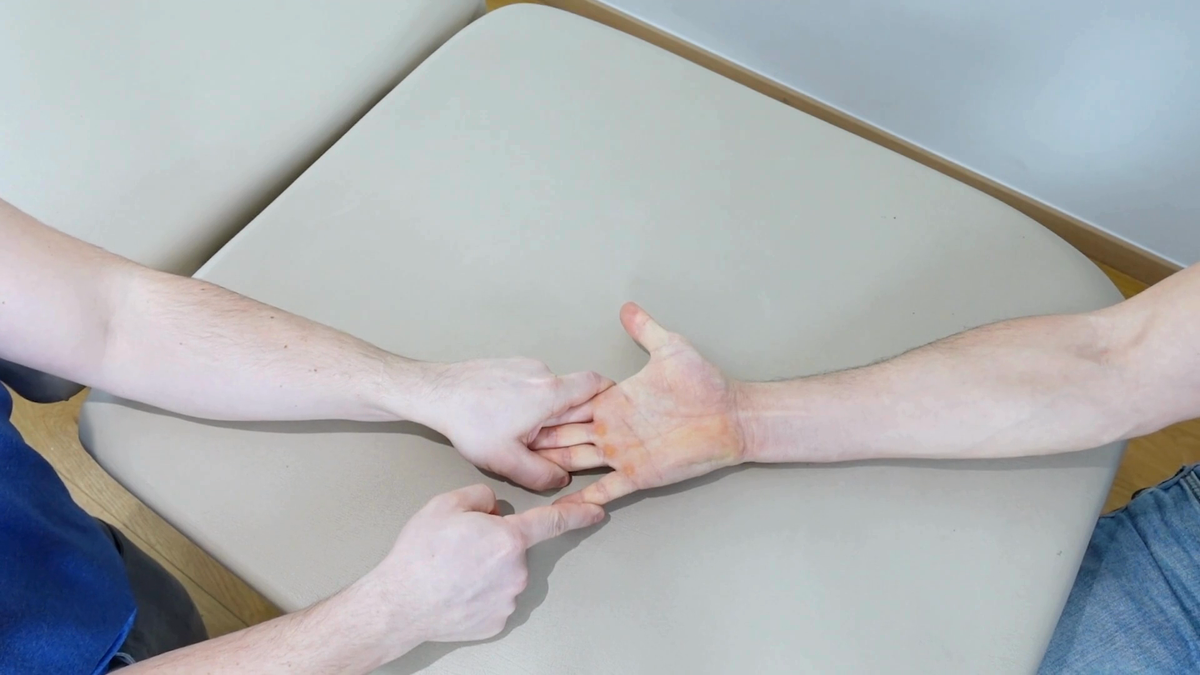
To perform the test, the patient’s forearm is placed in pronation in front of the physical therapist, who stabilizes the three middle fingers. The patient then performs abduction of the fifth finger against resistance. The same maneuver is then reproduced with the forearm in supination.
The test is positive if the patient experiences pain in the first dorsal compartment in at least one of the two forearm positions. For the test to be considered negative, the patient must experience no pain in either forearm position (Lee et al., 2023).
Clinical Value
According to the study by Lee et al., this test has a sensitivity of 91% and a specificity of 99%, making it a somewhat less sensitive but considerably more specific test than the Eichhoff Test (Lee et al., 2023).
Further studies are now needed to reproduce these findings and to examine other qualities of the Radial Synergy Test, such as its reliability or its use within a test cluster.
Bibliography
Adams JE, Habbu R. Tendinopathies of the hand and wrist. J Am Acad Orthop Surg. 2015;23(12):741-750.
Cheimonidou AZ, Lamnisos D, Lisacek-Kiosoglous A, et al. Validity and reliability of the finkelstein test. Trends in Medicine. 2019;19(2):1-7.
Elliott BG. Finkelstein’s test: a descriptive error that can produce a false positive. J Hand Surg Br. 1992;17(4):481-482.
Goel, Ritu, et Joshua M. Abzug. « de Quervain’s tenosynovitis: a review of the rehabilitative options ». Hand (New York, N.Y.) 10, no 1 (mars 2015): 1‑5.
Ilyas AM, Ast M, Schaffer AA, et al. De quervain tenosynovitis of the wrist. J Am Acad Orthop Surg. 2007;15(12):757-764.
Lee, C., Langford, P. N., Sullivan, G. E., Langford, M. A., Hogan, C. J., & Ruland, R. T. (2023). The Radial Synergy Test : An Aid to Diagnose de Quervain’s Tenosynovitis. Hand (New York, N.Y.), 18(2_suppl), 32S-37S.
Som, Aniruddh, Harrison R. Wermuth, et Paramvir Singh. « Finkelstein Sign ». In StatPearls. Treasure Island (FL): StatPearls Publishing, 2022.
Wolf JM, Sturdivant RX, Owens BD. Incidence of de Quervain’s tenosynovitis in a young, active population. J Hand Surg Am. 2009;34(1):112-115.
Wu, Feiran, Asim Rajpura, et Dilraj Sandher. « Finkelstein’s Test Is Superior to Eichhoff’s Test in the Investigation of de Quervain’s Disease ». Journal of Hand and Microsurgery 10, no 2 (août 2018): 116‑18.