Resources
Stay informed
Weight-Bearing Lunge Test

Contents
Test protocol
Context
The Weight-Bearing Lunge Test (WBLT) is commonly used to assess ankle dorsiflexion. For many lower limb injuries, assessing dorsiflexion range of motion is essential to identify risk factors (Willems et al., 2005) and alterations in gait or landing mechanics after a jump (Fong et al., 2011).
The WBLT has been used to detect range of motion deficits in patients with chronic ankle instability (Hoch et al., 2012), and it also allows monitoring of improvements in dorsiflexion throughout rehabilitation (Hoch et al., 2010).
As François Fourchet, a specialist in foot and ankle conditions, states, dorsiflexion range of motion must be fully restored in order to prevent long-term compensatory patterns.
Interventions targeting ankle dorsiflexion, whether through manual therapy or exercise-based approaches, not only improve outcomes on dorsiflexion-specific clinical tests, but also enhance performance on tests such as the Y Balance Test, as well as patient-reported outcome measures, including the FAAM (Hoch et al., 2012). Therefore, it is important to regularly monitor changes in dorsiflexion range of motion throughout the rehabilitation process.
Video of the Test
Execution
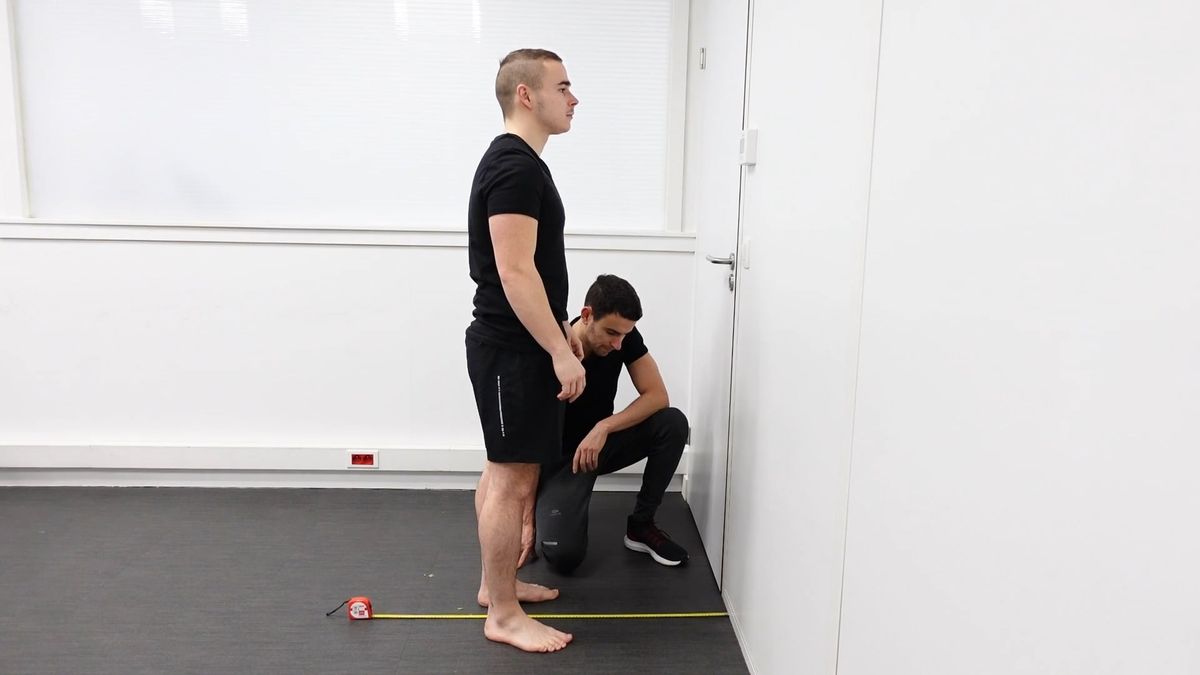
To perform the WBLT, the patient should be barefoot and stand or kneel facing a wall. The foot being assessed is positioned so that the hallux and calcaneus are aligned along a tape measure placed on the floor. The patient may place their hands on the wall to maintain stability. The patient is instructed to move the knee forward to touch the wall without lifting the heel from the ground. As long as this is achieved, the distance between the hallux and the wall is progressively increased until maximal ankle dorsiflexion is reached. The distance between the wall and the hallux is then measured in centimeters.
Clinical Value
The toe-to-wall distance obtained during the WBLT is a valid measure of ankle dorsiflexion (Hall and Docherty, 2017).
A typical distance of 10 to 12 cm between the hallux and the wall is generally observed (Hoch et al., 2011).
A systematic review by Powden et al. (2015) demonstrated strong evidence for good inter- and intra-rater reliability of the WBLT for assessing dorsiflexion range of motion. Based on all MDC values from the studies included in this review, inter-clinician changes of 4.6° or 1.6 cm and intra-clinician changes of 4.7° or 1.9 cm should be used in clinical practice to determine when changes are clinically meaningful.
Bibliography
Bennell, Kim L., Richard C. Talbot, Henry Wajswelner, Wassana Techovanich, David H. Kelly, and Andrew J. Hall. “Intra-Rater and Inter-Rater Reliability of a Weight-Bearing Lunge Measure of Ankle Dorsiflexion.” *The Australian Journal of Physiotherapy* 44, no. 3 (1998): 175–80.
Fong C-M, Blackburn JT, Norcross MF, et al. Ankle-dorsiflexion range of motion and landing biomechanics. J Athl Train. 2011; 46(1):5.
Hall, Emily A., et Carrie L. Docherty. « Validity of Clinical Outcome Measures to Evaluate Ankle Range of Motion during the Weight-Bearing Lunge Test ». *Journal of Science and Medicine in Sport* 20, no 7 (juillet 2017): 618‑21.
Hoch MC, Staton GS, Medina McKeon JM, et al. Dorsiflexion and dynamic postural control deficits are present in those with chronic ankle instability. J Sci Med Sport. 2012; 15(6):574-579.
Hoch, Matthew C., et Patrick O. McKeon. « Normative Range of Weight-Bearing Lunge Test Performance Asymmetry in Healthy Adults ». *Manual Therapy* 16, no 5 (octobre 2011): 516‑19.
Hoch MC, McKeon PO. The effectiveness of mobilization with movement at improving dorsiflexion after ankle sprain. J Sport Rehabil. 2010(19):226-232.Powden, Cameron J., Johanna M. Hoch, and Matthew C. Hoch. “Reliability and Minimal Detectable Change of the Weight-Bearing Lunge Test: A Systematic Review.” *Manual Therapy* 20, no. 4 (August 2015): 524–32.
Willems T, Witvrouw E, Delbaere K, et al. Intrinsic risk factors for inversion ankle sprains in females – a prospective study. Scand J Med Sci Sports. 2005; 15:336-345.