Resources
Stay informed
Kujala Anterior Knee Pain Scale (AKPS)
Contents
Tool content
Objective
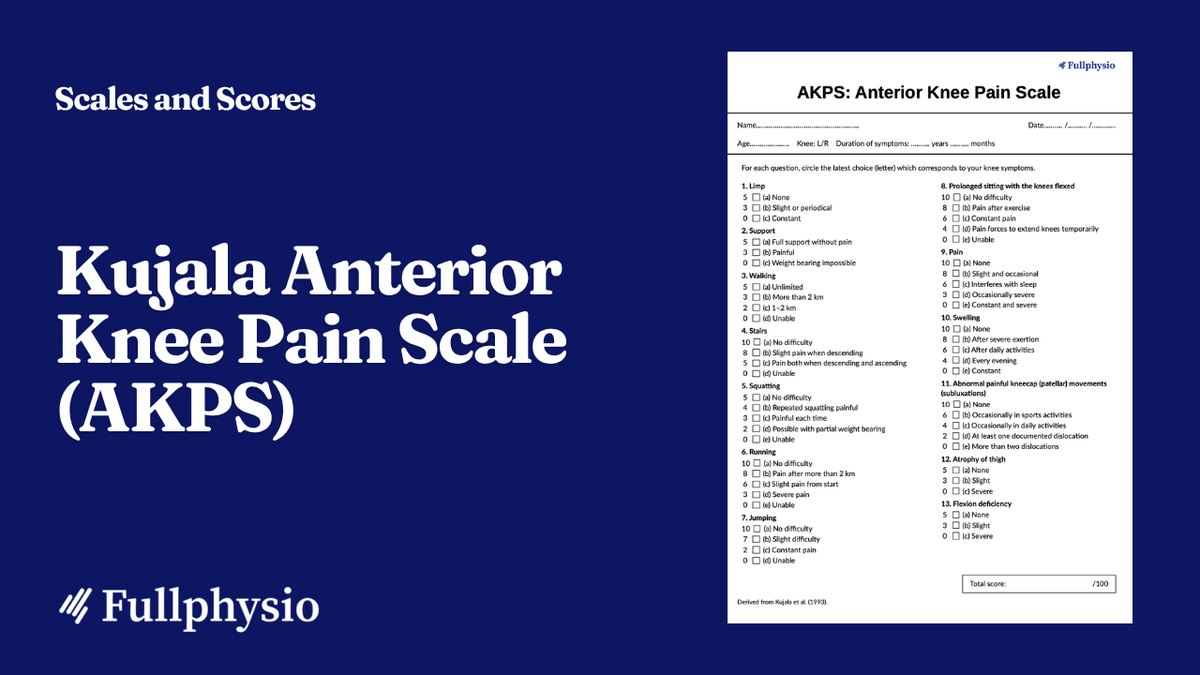
The Kujala Anterior Knee Pain Scale (Kujala AKPS) is a questionnaire used to assess subjective symptoms such as functional limitations and anterior knee pain.
Interpretation
0 = highly symptomatic patient.
100 = asymptomatic patient.
As a rough guide, patients with a score of 70 are considered to have a moderate disability.
The minimal clinically important difference (MCID) ranges from 7 to 14 points across studies.
Execution
This questionnaire consists of 13 items: 6 concerning the patient’s activities (walking, running, jumping, stairs, squatting, and prolonged sitting), and 7 concerning the patient’s symptoms (limp, support, pain, swelling, patellar maltracking, muscle atrophy, and flexion deficiency).
Duration
5 minutes.
Equipment
None.
Clinical Value
The Anterior Knee Pain Scale is reliable, valid, and responsive in patellofemoral pain, and a change of 10 points is considered clinically important (Crossley et al., 2004).
The internal consistency of the 13-item form is high (α = 0.91) (Ittenbach et al., 2016).
Acknowledgements
We thank Prof. Seppo K. Koskinen for allowing us to make the Kujala Anterior Knee Pain Scale available on Fullphysio.
Bibliography
Kujala, Urho M., Laura H. Jaakkola, Seppo K. Koskinen, Simo Taimela, Matti Hurme, and Olavi Nelimarkka. “Scoring of Patellofemoral Disorders.” Arthroscopy: The Journal of Arthroscopic & Related Surgery 9, no. 2 (1993): 159–63.
Crossley, Kay M., Kim L. Bennell, Sallie M. Cowan, and Sally Green. “Analysis of Outcome Measures for Persons with Patellofemoral Pain: Which Are Reliable and Valid?” Archives of Physical Medicine and Rehabilitation 85, no. 5 (2004): 815–22.
Ittenbach, Richard F., Guixia Huang, Kim D. Barber Foss, Timothy E. Hewett, and Gregory D. Myer. “Reliability and Validity of the Anterior Knee Pain Scale: Applications for Use as an Epidemiologic Screener.” PLOS ONE 11, no. 7 (2016): e0159204.