Resources
Stay informed
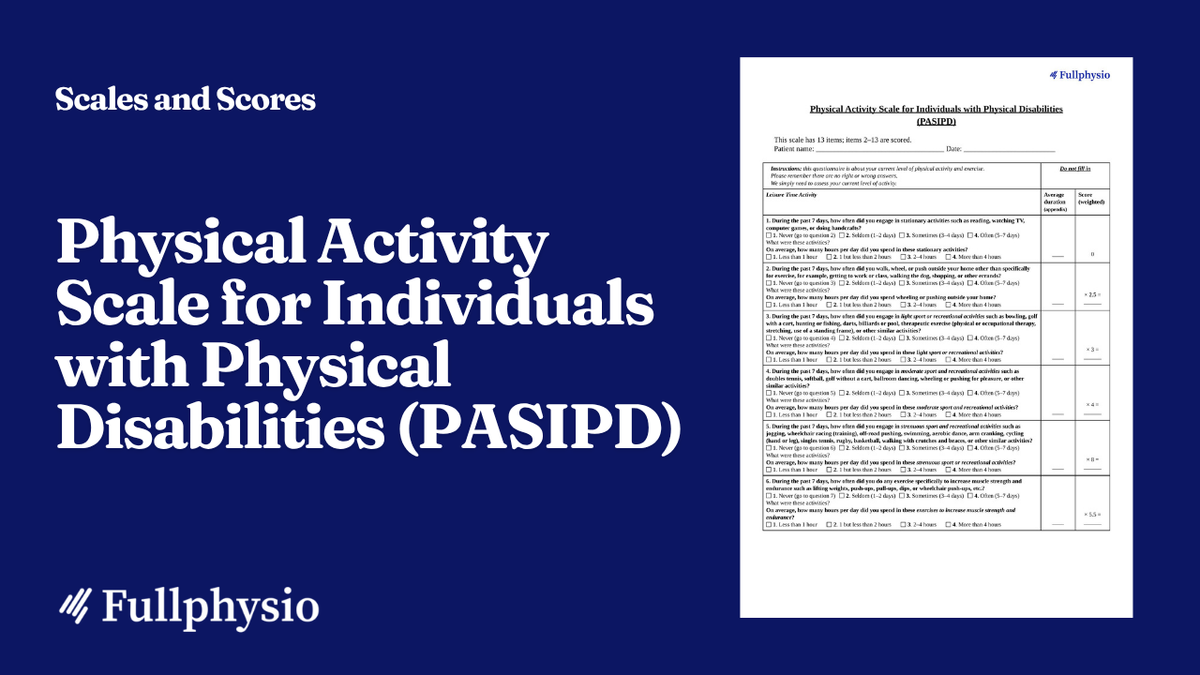
Physical Activity Scale for Individuals with Physical Disabilities (PASIPD)
Contents
Tool content
Objective
The Physical Activity Scale for Individuals with Physical Disabilities (PASIPD) is a questionnaire used to measure the level of physical activity among individuals with physical disabilities over the past seven days.¹ ² ³
Interpretation
The total PASIPD score ranges from 0 to 199.5; the scores for domains 1, 2, and 3 range from 0 to 98.7, 0 to 81.5, and 0 to 19.3 MET-h/d, respectively.⁴ ⁵
A higher score indicates a greater level of physical activity.
Description
The PASIPD consists of 13 items used to assess three different types of physical activity: leisure, household, and work-related activities.¹ ² ³ For each item, the patient is asked to indicate the number of days over the past seven days during which these activities were performed (never, seldom (1–2 days/week), sometimes (3–4 days/week), or often (5–7 days/week)), as well as the average number of hours per day spent on these activities (less than 1 hour, 1–2 hours, 2–4 hours, more than 4 hours). For item 13 on work-related activity, the time categories are different (less than 1 hour, 1–4 hours, 5–8 hours, 8 hours or more).⁴
The score for each item is calculated by multiplying an intensity-weighted MET value by the average number of hours per day.⁴ ⁵
The total score is obtained by summing items 2 through 13 and provides an estimate of daily energy expenditure, expressed as metabolic equivalent hours per day (MET-h/d).¹ ² ³
Duration
Approximately 5 minutes.¹
Equipment
None.
Clinical Value
The PASIPD is a valid instrument designed to measure physical activity in individuals with physical disabilities.¹
However, the PASIPD should be used with caution, and users should be aware of the limitations of the scale. It has demonstrated good concurrent validity, test-retest reliability, and acceptable measurement error, but its responsiveness is low.³
The PASIPD is also an appropriate measurement tool for assessing physical activity in people with Parkinson disease.⁵
Bibliography
1. Washburn, R. A., Zhu, W., McAuley, E., Frogley, M., & Figoni, S. F. (2002). The Physical Activity Scale for Individuals with Physical Disabilities: development and evaluation. Archives of Physical Medicine and Rehabilitation, 83(2), 193–200.
2. Meunier, P., Joussain, C., Gremeaux, V., Carnet, D., Bastable, P., Ruet, A., & Drigny, J. (2021). Transcultural adaptation and validation of a French version of the Physical Activity Scale for Individuals with Physical Disabilities (PASIPD-Fr). Annals of Physical and Rehabilitation Medicine, 64(4), 101423.
3. Declerck, L., Schutz, X., Kaux, J.-F., Stoquart, G., Lejeune, T., Vanderthommen, M., Cayrol, T., Selves, C., Van Beveren, J., & Beaudart, C. (2022). Standard error of measurement and minimal detectable change of the French physical activity scale for individuals with physical disabilities. Annals of Physical and Rehabilitation Medicine, 65(3), 101583.
4. Ulaş, K., Topuz, S., & Dinç Horasan, G. (2019). The validity and reliability of the Turkish version of the Physical Activity Scale for Individuals with Physical Disabilities (PASIPD). Turkish Journal of Medical Sciences, 49(6), 1620–1625.
5. Jimenez-Pardo, J., Holmes, J. D., Jenkins, M. E., & Johnson, A. M. (2015). An Examination of the Reliability and Factor Structure of the Physical Activity Scale for Individuals With Physical Disabilities (PASIPD) Among Individuals Living With Parkinson’s Disease. Journal of Aging and Physical Activity, 23(3), 391–394.