Resources
Stay informed
SPADI: Shoulder Pain and Disability Index
Contents
Tool content
Objective
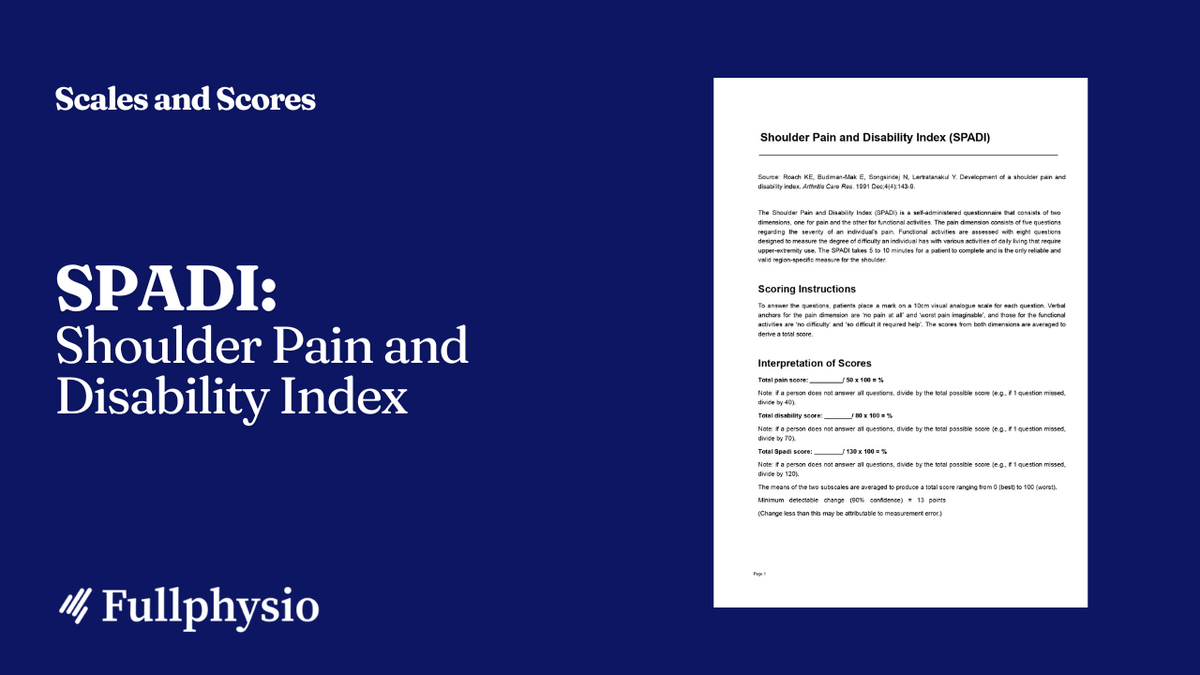
The Shoulder Pain and Disability Index (SPADI) is a self-administered questionnaire including 13 items evaluating 2 dimensions: pain levels and the degree of impairment in ADLs requiring the use of the upper limbs. This questionnaire can be used in patients suffering from:
- shoulder pain;
- rotator cuff disorders;
- osteoarthritis of the shoulder;
- rheumatoid polyarthritis;
- frozen shoulder;
- shoulder prosthesis.
Interpretation
The SPADI score is often presented as a percentage. The following calculations are carried out:
- the pain score is calculated as the sum of the points of the 5 items relating to pain, divided by 50 and multiplied by 100;
- the disability score is calculated as the sum of the points of the 8 items relating to disability, divided by 80 and multiplied by 100;
- the total SPADI score is calculated as the sum of all the elements, divided by 130 and multiplied by 100.
While grading the SPADI, each missed question must be subtracted from the total score of each sub-scale. Therefore, if a question is omitted from the section on pain, the total score is divided by 40.
It is considered that the higher the score is on each scale, the higher the impairment of shoulder function is. The minimum detectable changes with 90% confidence are 18% for the first scale, 13% for the second scale, and 11% for the total score.
A change of 8 points is generally considered clinically relevant for distinguishing improvements following treatment in patients with a shoulder condition (Paul et al., 2004).
Execution
There are two versions of the SPADI. The original version was published in 1991 and its elements are graded on the Visual Analogue Scale (VAS), while the second version’s elements are graded on the Numeric Rating Scale (NRS).
Each of the 13 elements should be graded with a number from 0 to 10:
- For the pain score (first 5 items): 0 means no pain and 10 means the worst imaginable pain. The results go from 0 to 50.
- For the disability score (last 8 items): 0 means no impairment and 10 means that the patient needs help to complete the action in question. The results go from 0 to 80.
The patient is encouraged to choose the number that best describes their level of pain and their degree of difficulty in using the affected shoulder. The overall result will therefore lie somewhere between 0 and 130.
Time Needed
Less than 5 minutes. This questionnaire is valued for how quick it is to administer.
Clinical Value
The SPADI has proven to have an ICC reliability coefficient ≥ 0.89 in diverse patient populations (Roy et al., 2009).
The SPADI demonstrates good construct validity, and compared favorably with other region-specific shoulder questionnaires (Paul et al., 2004; Roy et al., 2009; Bot et al., 2004).
This score showed sensitivity to change over time and a sufficient discriminatory capacity to differentiate patients whose situation is improving or deteriorating (William et al., 1995; Beaton et al., 1996; Roy et al., 2009).
Acknowledgements
The SPADI was developed by Kathryn E. Roach, Elly Budiman-Mak, Norwarat Songsiridej, and Yongsuk Lertratanakul. We would like to thank Professor Kathryn E. Roach for allowing us to make the SPADI available on Fullphysio. Original publication: Roach KE, Budiman-Mak E, Songsiridej N, Lertratanakul Y. Development of a shoulder pain and disability index. Arthritis Care Res. 1991;4(4):143–149.
Bibliography
Beaton, D. E., and R. R. Richards. “Measuring Function of the Shoulder. A Cross-Sectional Comparison of Five Questionnaires.” The Journal of Bone and Joint Surgery. American Volume 78, no. 6 (June 1996): 882–90. https://doi.org/10.2106/00004623-199606000-00011. https://doi.org/10.2106/00004623-199606000-00011
Breckenridge, J., & McAuley, J. (2011). Shoulder Pain and Disability Index (SPADI). Australian Physiotherapy Association, 57(3):197. doi: 10.1016/S1836-9553(11)70045-5.
Bot, S. D. M., C. B. Terwee, D. a. W. M. van der Windt, L. M. Bouter, J. Dekker, and H. C. W. de Vet. “Clinimetric Evaluation of Shoulder Disability Questionnaires: A Systematic Review of the Literature.” Annals of the Rheumatic Diseases 63, no. 4 (April 2004): 335–41. https://doi.org/10.1136/ard.2003.007724.
MacDermid, Joy C., Patty Solomon, and Kenneth Prkachin. “The Shoulder Pain and Disability Index Demonstrates Factor, Construct and Longitudinal Validity.” BMC Musculoskeletal Disorders 7, no. 1 (February 10, 2006): 12. https://doi.org/10.1186/1471-2474-7-12.
Paul, A., M. Lewis, M. F. Shadforth, P. R. Croft, D. a. W. M. Van Der Windt, and E. M. Hay. “A Comparison of Four Shoulder-Specific Questionnaires in Primary Care.” Annals of the Rheumatic Diseases 63, no. 10 (October 2004): 1293–99. https://doi.org/10.1136/ard.2003.012088.
Roach, K. E., E. Budiman-Mak, N. Songsiridej, and Y. Lertratanakul. “Development of a Shoulder Pain and Disability Index.” Arthritis Care and Research: The Official Journal of the Arthritis Health Professions Association 4, no. 4 (December 1991): 143–49.
Roy, Jean-Sébastien, Joy C. MacDermid, and Linda J. Woodhouse. “Measuring Shoulder Function: A Systematic Review of Four Questionnaires.” Arthritis and Rheumatism 61, no. 5 (May 15, 2009): 623–32. https://doi.org/10.1002/art.24396.
Tveitå, Einar Kristian, Ole Marius Ekeberg, Niels Gunnar Juel, and Erik Bautz-Holter. “Responsiveness of the Shoulder Pain and Disability Index in Patients with Adhesive Capsulitis.” BMC Musculoskeletal Disorders 9, no. 1 (December 3, 2008): 161. https://doi.org/10.1186/1471-2474-9-161.
Williams, J. W., D. R. Holleman, and D. L. Simel. “Measuring Shoulder Function with the Shoulder Pain and Disability Index.” The Journal of Rheumatology 22, no. 4 (April 1995): 727–32.