Resources
Stay informed
AB-HEER Test
Contents
Test protocol
Context
Hip microinstability, or atraumatic instability, is an emerging cause of pain and functional limitation in active young patients and athletes (Kalisvaart et al., 2015). It corresponds to extraphysiological movement or joint laxity, leading to abnormal hip mechanics (Shu et al., 2011).
Often related to repeated stress (axial or rotational), it is frequently associated with capsuloligamentous laxity, muscle weakness, or subtle bone abnormalities (Boykin et al., 2011; Moorman et al., 2003). Diagnosis remains difficult in the absence of clear criteria on clinical examination or imaging, and because of the deep, dynamic nature of the joint (Shu et al., 2011).
Clinical tests can help detect this instability, but few have been scientifically validated. Hoppe et al. (2017) assessed the diagnostic validity of three physical tests, including the Abduction-Hyperextension-External Rotation (AB-HEER) Test to objectify this condition.
Video of the Test

Execution
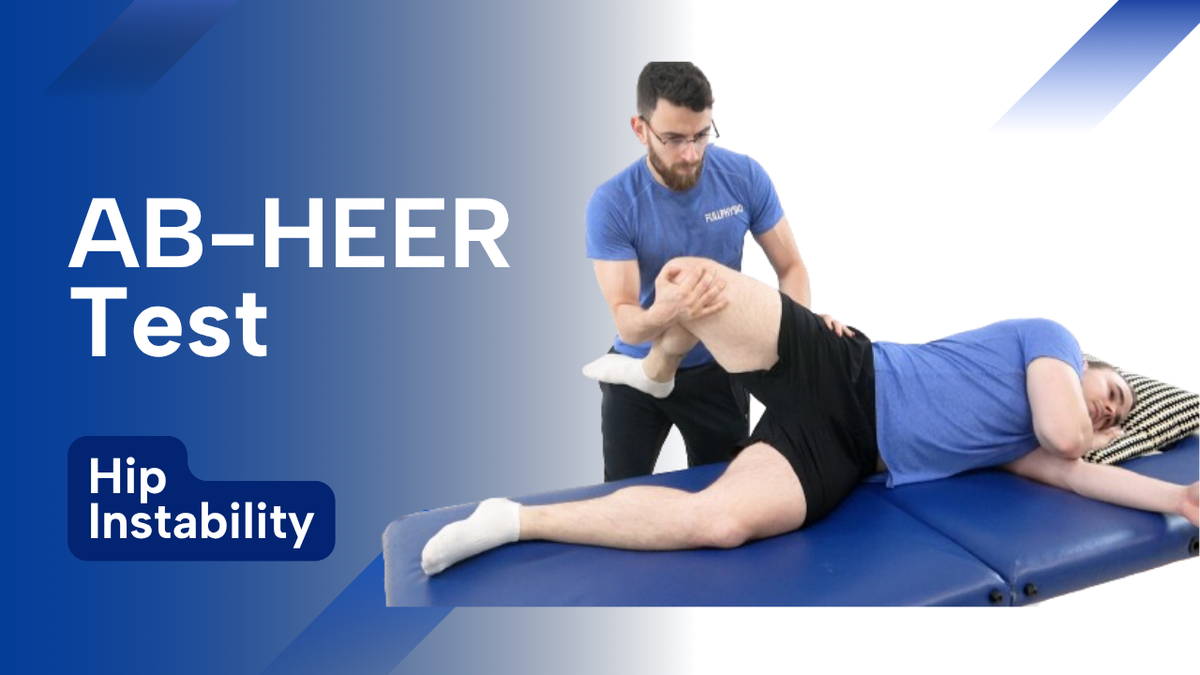
The patient is placed on their side, in the side-lying position. The clinician then flexes the patient’s knee to 90°. The hip is positioned in 30°–45° abduction, extension, and external rotation. A forward force is applied to the greater trochanter. The test is considered positive if this maneuver produces pain at the anterior hip.
Clinical Value
According to the authors, the AB-HEER Test was overall the most accurate test, with the highest sensitivity (80.6%), negative predictive value (77.8%), and overall accuracy (84.4%), and the second-highest specificity (89.4%) (Hoppe et al., 2017).
Bibliography
Hoppe, Daniel J., Jeremy N. Truntzer, Lauren M. Shapiro, Geoffrey D. Abrams, et Marc R. Safran. « Diagnostic Accuracy of 3 Physical Examination Tests in the Assessment of Hip Microinstability ». Orthopaedic Journal of Sports Medicine 5, no 11 (novembre 2017): 2325967117740121.