Resources
Stay informed
Anterior Knee Pain Provocation (AKPP) Test
Contents
Test protocol
Context
Patellofemoral pain or PFP is a common knee pain complaint affecting 1 in 14 adolescents, according to Smith et al. (2018) and characterized by non-traumatic peri- or retropatellar pain (Crossley et al., 2016). Pain usually develops gradually, fluctuates, and is aggravated by activities that stress the patellofemoral joint, such as stair step-ups, squats and running. Although the condition is more common in people involved in sport, it can also occur in non-athletes (Rathleff et al., 2015; Smith et al., 2018).
To track pain and function, US clinical practice guidelines recommend the Anterior Knee Pain Scale (AKPS, Kujala) or the KOOS-PF subscale, among others (Willy et al., 2019). These questionnaires, like the KOOS or Pedi-IKDC, reflect pain during activities over the previous week (Rathleff et al., 2022). A test performed during the session provokes symptoms “in real time” and therefore better reflects current pain in a condition that fluctuates (Loudon et al., 2002; Rathleff et al., 2022).
A key feature of PFP is pain during loading of a flexed knee (Crossley et al., 2016; Willy et al., 2019). Pain associated with high loading, such as jumping or squatting, is thought to be due to high joint stress in the patellofemoral joint. The theoretical mechanism is that a high load in the patellofemoral joint affects structures that may contribute to nociception (i.e., subchondral bone, infrapatellar fat pad, retinaculum, and ligamentous structures) (Powers et al., 2017).
Lacking a simple, clinically feasible test to evaluate and track pain during loading, Rathleff et al. (2022) developed the 45-Second Anterior Knee Pain Provocation (AKPP) Test: a 45-second unilateral test that loads a flexed knee to provoke patellofemoral pain. It was evaluated in adolescents aged 10 to 14 as a monitoring tool, not a diagnostic test (Rathleff et al., 2022).
Test Procedure

Patient instructions—before the test, explain the Numeric Pain Rating Scale (NPRS): “0 means no pain, and 10 means the worst pain imaginable” (Rathleff et al., 2022).
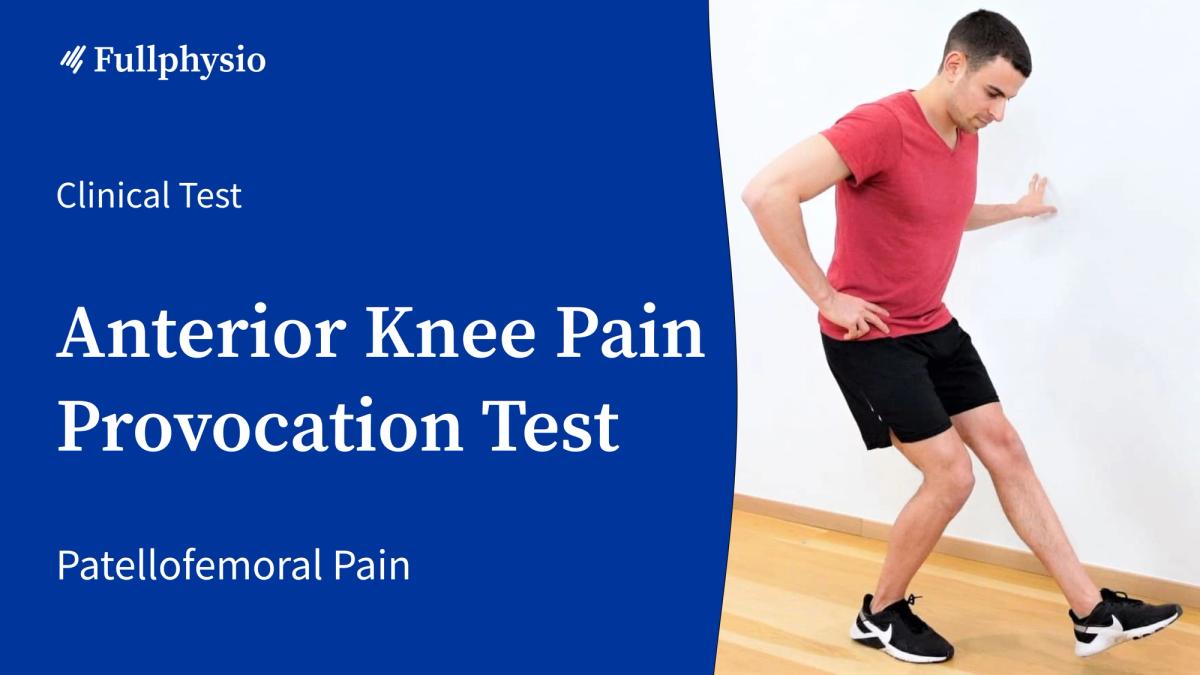
Setup and procedure—the patient stands on the test leg with the trunk leaning slightly forward and may place one hand on the wall for balance. They bend the knee to 60° in a static single-leg squat and hold the position for 45 seconds (Rathleff et al., 2022).
Score—immediately after the 45-second hold, the patient rates their knee pain intensity on the NPRS from 0 to 10: what counts is the pain at the end of the test (Rathleff et al., 2022).
Clinical Value
Discriminative ability. The test provoked a median pain of 5/10 in 151 adolescents aged 10 to 14 with PFP, compared with 0/10 in 50 adolescents without knee pain; the area under the ROC curve (0.90) indicates good separation between the two groups (Rathleff et al., 2022). The authors’ cutoff is 1.25/10. Because scores are whole numbers, this corresponds to pain of at least 2/10 at the end of the test; the cutoff has not been validated in another sample.
What the test does not tell you. These figures compare PFP with the absence of pain. The test is not diagnostic: pain during loading of a flexed knee is also found in Osgood-Schlatter disease, patellar tendinopathy, and Sinding-Larsen-Johansson disease (Gholve et al., 2007; Malliaras et al., 2015; Rathleff et al., 2022).
Construct validity. The more pain the test provoked, the worse the KOOS Pain and Sport/Rec scores; the authors consider this association moderate, slightly below the 0.50 threshold usually expected (Rathleff et al., 2022).
Responsiveness. Over 12 weeks of management (education, activity modification, and home exercises), pain on the test decreased by an average of 0.8 points at 4 weeks and 2.9 points at 12 weeks (Rathleff et al., 2022). With no control group, this cohort cannot separate the effect of treatment from natural recovery (Rathleff et al., 2019).
This decrease went hand in hand with improvement in KOOS Pain (r = −0.48) and Sport/Rec (r = −0.40) (Rathleff et al., 2022).
Reliability and measurement error. Neither test-retest reliability nor the minimal detectable change has been studied (Rathleff et al., 2022). We therefore do not know what decrease indicates real progress: a decrease of about 1 point cannot be confidently interpreted; compare it with changes in questionnaires and activity levels.
Population. A single study, in 10- to 14-year-olds, by the team that developed the test (Rathleff et al., 2022); to our knowledge (PubMed, October 2026), no replication or study in adults has been published: the cutoff and changes do not directly apply to adults.
Further reading. Other clinical examination tests: Patellofemoral Pain Module, part “Assessment & Diagnosis.” Suspected patellar instability: Patellar Apprehension Test. Monitoring function: Kujala Anterior Knee Pain Scale (AKPS). Mechanisms: Masterclass “Integrating Biomechanics and Psychological Factors in Patellofemoral Pain.”
In practice. The score is a single number, easy to communicate and track; such tracking may help identify management that is stalling (Rathleff et al., 2022). According to the Dutch guideline, the diagnosis of PFP should be reconsidered if pain and function do not improve after 12 weeks of structured quadriceps- and/or hip-focused exercise therapy (Ophey et al., 2025).
Clinimetric summary (property: value). Single source: Rathleff et al., 2022 (ages 10–14, PFP vs. no pain).
- Provoked pain (median): 5/10 (IQR 3–7) with PFP vs. 0/10 (0–0) without pain
- Discrimination, PFP vs. no pain (area under the ROC curve): 0.90 (95% CI 0.85–0.95)
- Cutoff: 1.25/10, i.e., ≥2/10 in practice; not validated in another cohort
- Sensitivity, specificity, LR+: not reported (internal inconsistency in the article)
- Association with KOOS at baseline: |r| = 0.47 (Pain) and 0.33 (Sport/Rec)
- Change with treatment (no control group): −0.8 points at 4 weeks; −2.9 points at 12 weeks
- Change on test vs. change in KOOS (12 weeks): r = −0.48 (Pain); −0.40 (Sport/Rec)
- Test-retest reliability: not established to date
- Minimal detectable change (MDC): not established to date
- Validity in adults: not established to date
- Distinction from other anterior knee pain conditions: not established to date
Bibliography
Crossley, K. M., Stefanik, J. J., Selfe, J., Collins, N. J., Davis, I. S., Powers, C. M., McConnell, J., Vicenzino, B., Bazett-Jones, D. M., Esculier, J.-F., Morrissey, D., & Callaghan, M. J. (2016). 2016 Patellofemoral pain consensus statement from the 4th International Patellofemoral Pain Research Retreat, Manchester. Part 1: Terminology, definitions, clinical examination, natural history, patellofemoral osteoarthritis and patient-reported outcome measures. British Journal of Sports Medicine, 50(14), 839–843. https://doi.org/10.1136/bjsports-2016-096384
Gholve, P. A., Scher, D. M., Khakharia, S., Widmann, R. F., & Green, D. W. (2007). Osgood Schlatter syndrome. Current Opinion in Pediatrics, 19(1), 44–50. https://doi.org/10.1097/mop.0b013e328013dbea
Loudon, J. K., Wiesner, D., Goist-Foley, H. L., Asjes, C., & Loudon, K. L. (2002). Intrarater Reliability of Functional Performance Tests for Subjects With Patellofemoral Pain Syndrome. Journal of Athletic Training, 37(3), 256–261.
Malliaras, P., Cook, J., Purdam, C., & Rio, E. (2015). Patellar Tendinopathy: Clinical Diagnosis, Load Management, and Advice for Challenging Case Presentations. Journal of Orthopaedic & Sports Physical Therapy, 45(11), 887–898. https://doi.org/10.2519/jospt.2015.5987
Ophey, M., Koëter, S., van Ooijen, L., van Ark, M., Boots, F., Ilbrink, S., Lankhorst, N. A., Piscaer, T., Vestering, M., den Ouden Vierwind, M., van Linschoten, R., & van Berkel, S. (2025). Dutch multidisciplinary guideline on anterior knee pain: Patellofemoral pain and patellar tendinopathy. Knee Surgery, Sports Traumatology, Arthroscopy, 33(2), 457–469. https://doi.org/10.1002/ksa.12367
Powers, C. M., Witvrouw, E., Davis, I. S., & Crossley, K. M. (2017). Evidence-based framework for a pathomechanical model of patellofemoral pain: 2017 patellofemoral pain consensus statement from the 4th International Patellofemoral Pain Research Retreat, Manchester, UK: part 3. British Journal of Sports Medicine, 51(24), 1713–1723. https://doi.org/10.1136/bjsports-2017-098717
Rathleff, M. S., Graven-Nielsen, T., Hölmich, P., Winiarski, L., Krommes, K., Holden, S., & Thorborg, K. (2019). Activity Modification and Load Management of Adolescents With Patellofemoral Pain: A Prospective Intervention Study Including 151 Adolescents. The American Journal of Sports Medicine, 47(7), 1629–1637. https://doi.org/10.1177/0363546519843915
Rathleff, M. S., Holden, S., Krommes, K., Winiarski, L., Hölmich, P., Salim, T. J., & Thorborg, K. (2022). The 45-second anterior knee pain provocation test: A quick test of knee pain and sporting function in 10–14-year-old adolescents with patellofemoral pain. Physical Therapy in Sport, 53, 28–33. https://doi.org/10.1016/j.ptsp.2021.11.002
Rathleff, M. S., Roos, E. M., Olesen, J. L., & Rasmussen, S. (2015). Exercise during school hours when added to patient education improves outcome for 2 years in adolescent patellofemoral pain: A cluster randomised trial. British Journal of Sports Medicine, 49(6), 406–412. https://doi.org/10.1136/bjsports-2014-093929
Smith, B. E., Selfe, J., Thacker, D., Hendrick, P., Bateman, M., Moffatt, F., Rathleff, M. S., Smith, T. O., & Logan, P. (2018). Incidence and prevalence of patellofemoral pain: A systematic review and meta-analysis. PLOS ONE, 13(1), e0190892. https://doi.org/10.1371/journal.pone.0190892
Willy, R. W., Hoglund, L. T., Barton, C. J., Bolgla, L. A., Scalzitti, D. A., Logerstedt, D. S., Lynch, A. D., Snyder-Mackler, L., & McDonough, C. M. (2019). Patellofemoral Pain. Journal of Orthopaedic & Sports Physical Therapy, 49(9), CPG1–CPG95. https://doi.org/10.2519/jospt.2019.0302