Resources
Stay informed
Cervical Flexion-Rotation Test

Contents
Test protocol
Context
Restrictions in upper cervical spine mobility have been associated with neck pain and headaches (Malo-Urriés et al., 2017; Dunning et al., 2012). Most rotational movement of the upper cervical spine occurs in the C1–C2 segment (Hidalgo-García et al., 2016). The Flexion-Rotation Test is the most commonly used test to assess range of motion (ROM) in the transverse plane of the upper cervical spine, and it is a recommended test for the evaluation of patients with headache disorders (Hall et al., 2008; Takasaki et al., 2011; Luedtke et al., 2016; Rodríguez-Sanz et al., 2020; González-Rueda et al., 2020; Pu et al., 2023). This test is an easy-to-administer manual examination method that identifies the presence of joint dysfunction at the C1–C2 level (Ogince et al., 2007).
Video of the Test
Execution
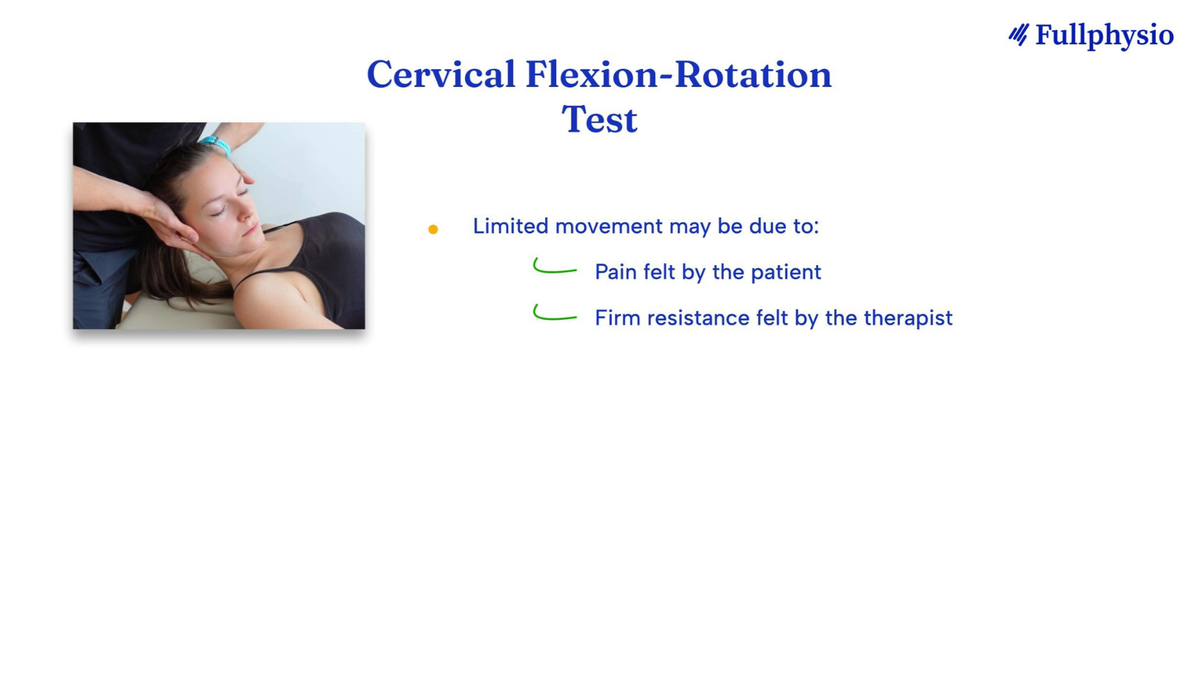
To perform the CFRT, the patient lies in a supine position. The therapist brings the patient’s cervical spine into full flexion and then adds rotation to each side, one side at a time, until the end range of motion is reached, which averages 44° in healthy subjects.
The movement restriction may be due to pain reported by the patient or to a firm end feel perceived by the therapist.
The Flexion-Rotation Test is considered positive if the range of motion is less than 33° on one side or if there is a 10° difference between sides (Ogince et al., 2007; Hall et al., 2004).
Clinical Value
Although it is considered a test for assessing rotation at the C1–C2 segment, the presence of painful joints in the lower cervical spine reduced the available range of motion during the Flexion-Rotation Test to 37.5° (Rubio-Ochoa et al., 2010). This indicates that pain in the lower cervical spine may reduce the ROM recorded during the Flexion-Rotation Test (Satpute et al., 2019).
This test has been shown to have high sensitivity (90%-91%) and specificity (88%-90%), as well as excellent test-retest reliability (ICC = 0.92), when used to examine patients with cervicogenic headache (Ogince et al., 2007; Hall et al., 2008; Kim and Shin, 2024).
Bibliography
Malo-Urriés, Miguel, José Miguel Tricás-Moreno, Elena Estébanez-de-Miguel, César Hidalgo-García, Andoni Carrasco-Uribarren, et Sara Cabanillas-Barea. « Immediate Effects of Upper Cervical Translatoric Mobilization on Cervical Mobility and Pressure Pain Threshold in Patients With Cervicogenic Headache: A Randomized Controlled Trial ». Journal of Manipulative and Physiological Therapeutics 40, nᵒ 9 (décembre 2017): 649‑58.
Dunning, James R., Joshua A. Cleland, Mark A. Waldrop, Cathy F. Arnot, Ian A. Young, Michael Turner, et Gisli Sigurdsson. « Upper Cervical and Upper Thoracic Thrust Manipulation versus Nonthrust Mobilization in Patients with Mechanical Neck Pain: A Multicenter Randomized Clinical Trial ». The Journal of Orthopaedic and Sports Physical Therapy 42, no 1 (janvier 2012): 5‑18.
Hidalgo-García, César, José Miguel Tricás-Moreno, Orosia Lucha-López, Elena Estebanezde Miguel, Elena Bueno-Gracia, Silvia Pérez-Guillén, Pablo Fanlo-Mazas, Alazne Ruiz-de-Escudero, et John Krauss. « Short Term Efficacy of C0-C1 Mobilization in the Cervical Neutral Position in Upper Cervical Hypomobility: A Randomized Controlled Trial ». Journal of International Academy of Physical Therapy Research 7, no 1 (31 mars 2016): 908‑14.
Hall, Toby M., Kim W. Robinson, Osamu Fujinawa, Kiyokazu Akasaka, et Elizabeth A. Pyne. « Intertester Reliability and Diagnostic Validity of the Cervical Flexion-Rotation Test ». Journal of Manipulative and Physiological Therapeutics 31, no 4 (mai 2008): 293‑300.
Kim, W.-D., & Shin, D. (2024). Physical Factors Associated with Non-Specific Neck Pain : Correlations Among Pain, Disability, Posture, Endurance, and Compensatory Movement. Medical Science Monitor : International Medical Journal of Experimental and Clinical Research, 30, e944614-1-e944614-8.
Luedtke, K., Boissonnault, W., Caspersen, N., Castien, R., Chaibi, A., Falla, D., Fernández-de-Las-Peñas, C., Hall, T., Hirsvang, J. R., Horre, T., Hurley, D., Jull, G., Krøll, L. S., Madsen, B. K., Mallwitz, J., Miller, C., Schäfer, B., Schöttker-Königer, T., Starke, W., … May, A. (2016). International consensus on the most useful physical examination tests used by physiotherapists for patients with headache : A Delphi study. Manual Therapy, 23, 17‑24.
Pu, L. L., Miller, E., & Schenk, R. (2023). Utilizing directional preference in the management of cervicogenic headache : A case series. The Journal of Manual & Manipulative Therapy, 31(6), 466‑473.
Takasaki, Hiroshi, Toby Hall, Sadanori Oshiro, Shouta Kaneko, Yoshikazu Ikemoto, et Gwendolen Jull. « Normal Kinematics of the Upper Cervical Spine during the Flexion-Rotation Test - In Vivo Measurements Using Magnetic Resonance Imaging ». Manual Therapy 16, no 2 (avril 2011): 167‑71.
Rodríguez-Sanz, Jacobo, Miguel Malo-Urriés, Jaime Corral-de-Toro, Carlos López-de-Celis, María Orosia Lucha-López, José Miguel Tricás-Moreno, Ana I. Lorente, et César Hidalgo-García. « Does the Addition of Manual Therapy Approach to a Cervical Exercise Program Improve Clinical Outcomes for Patients with Chronic Neck Pain in Short- and Mid-Term? A Randomized Controlled Trial ». International Journal of Environmental Research and Public Health 17, no 18 (10 septembre 2020): E6601.
González-Rueda, Vanessa, César Hidalgo-García, Jacobo Rodríguez-Sanz, Elena Bueno-Gracia, Albert Pérez-Bellmunt, Pere Ramón Rodríguez-Rubio, et Carlos López-de-Celis. « Does Upper Cervical Manual Therapy Provide Additional Benefit in Disability and Mobility over a Physiotherapy Primary Care Program for Chronic Cervicalgia? A Randomized Controlled Trial ». International Journal of Environmental Research and Public Health 17, nᵒ 22 (11 novembre 2020): E8334.
Ogince, Mark, Toby Hall, Kim Robinson, et A. M. Blackmore. « The Diagnostic Validity of the Cervical Flexion-Rotation Test in C1/2-Related Cervicogenic Headache ». Manual Therapy 12, no 3 (août 2007): 256‑62. Hall, T., et K. Robinson. « The Flexion-Rotation Test and Active Cervical Mobility--a Comparative Measurement Study in Cervicogenic Headache ». Manual Therapy 9, no 4 (novembre 2004): 197‑202.
Rubio-Ochoa, J., J. Benítez-Martínez, E. Lluch, S. Santacruz-Zaragozá, P. Gómez-Contreras, et C. E. Cook. « Physical Examination Tests for Screening and Diagnosis of Cervicogenic Headache: A Systematic Review ». Manual Therapy 21 (février 2016): 35‑40.
Satpute, Kiran, Sadaf Nalband, et Toby Hall. « The C0-C2 Axial Rotation Test: Normal Values, Intra- and Inter-Rater Reliability and Correlation with the Flexion Rotation Test in Normal Subjects ». The Journal of Manual & Manipulative Therapy 27, no 2 (mai 2019): 92‑98.