Resources
Stay informed
Lever Sign (Lelli Test)

Contents
Test protocol
Context
The Lever Sign, or Lelli Test, was recently proposed as a diagnostic tool for anterior cruciate ligament (ACL) tears.
With the increasing prevalence of ACL tears, there is a growing need for clinical tests to either confirm or rule out a suspected ACL tear.
The Lachman Test and the Pivot Shift Test require the clinician to stabilize one segment of the leg while manipulating the other. This can prove challenging and yield inaccurate test results when the patient's leg exceeds the circumference or weight the therapist is able to manage. Therefore, a test that places the clinician in a biomechanical advantage may prove more practical. For this reason, in 2016, Lelli and colleagues introduced the Lever Sign.
Video of the Test

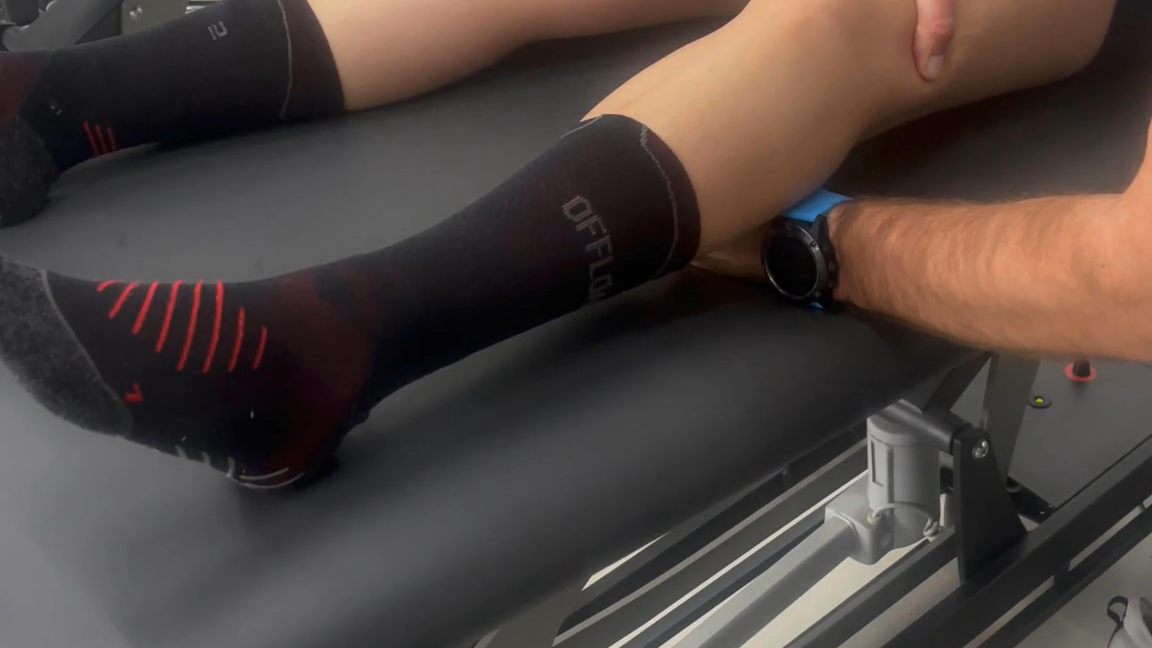
A big thank you to Florian Forelli, physiotherapist, PhD, and Assistant Professor of Physiotherapy, for sharing this video with us.
Execution
To perform this test, the patient lies in supine and the therapist places a fist under the proximal portion of the calf to serve as a fulcrum. In this position, the knee is placed at approximately 30° of flexion, which is the angle at which the anterior tibial translation on the femur is greatest.
The therapist's opposite hand then applies a downward force just proximal to the knee joint. With an intact ACL, the heel should lift off the table, indicating a negative test. A disruption of the ACL will result in the heel remaining on the table, indicating a positive test.
Clinical Value
A systematic review and meta-analysis conducted by Abruscato et al. in 2019 reported that the Lever Sign had good clinical utility in practice, with a sensitivity of 0.77 and a specificity of 0.90.
Abruscato and colleagues (2019) concluded that the Lever Sign, when used together with other tests, can help provide the therapist with a more complete clinical picture of the status of the ACL.
The Lever Sign appears to be more reliable, accurate, and sensitive in the diagnosis of acute ACL injuries and less so in chronic injuries (Guiraud et al., 2022; Avasthi et al., 2024). Its use as part of a test battery is encouraged in the recent scientific literature to increase diagnostic accuracy (Bucher et al., 2022; Sarhan et al., 2023; Hu et al., 2024).
Bibliography
Abruscato, Kristin, Kelsie Browning, Daniel Deleandro, Quinn Menard, Mark Wilhelm, et Amy Hassen. « DIAGNOSTIC ACCURACY OF THE LEVER SIGN IN DETECTING ANTERIOR CRUCIATE LIGAMENT TEARS: A SYSTEMATIC REVIEW AND META-ANALYSIS ». International Journal of Sports Physical Therapy 14, no 1 (février 2019): 2‑13.
Avasthi, S., Aggarwal, P., Mahapatra, S., Nishat, N., Mishra, M., & Aslam, A. (2024). Diagnostic accuracy of lever sign test in acute and chronic ACL injuries. Journal of Clinical Orthopaedics and Trauma, 52, 102427.
Bucher, C., Lamy, D., Debaty, G., Pailhé, R., & Saragaglia, D. (2022). Validity of the lever sign test for the clinical diagnosis of anterior cruciate ligament tears : Assessments in ski resorts. Orthopaedics & Traumatology, Surgery & Research: OTSR, 108(3), 103254.
Guiraud, K., Silvestre, G., Bastin, C., Lecouvet, F. E., Benitez Masip, A., Boyadzhiev, D., Meert, P., & Thienpont, E. (2022). Higher sensitivity with the lever sign test for diagnosis of anterior cruciate ligament rupture in the emergency department. Archives of Orthopaedic and Trauma Surgery, 142(8), 1979‑1983.
Hu, S., Wang, X., Wang, Q., & Feng, W. (2024). Lever sign test for anterior cruciate ligament injuries : A diagnostic meta-analysis. Journal of Orthopaedic Surgery and Research, 19(1), 155.
Lelli, Alessandro, Rita Paola Di Turi, David B. Spenciner, et Marcello Dòmini. « The “Lever Sign”: A New Clinical Test for the Diagnosis of Anterior Cruciate Ligament Rupture ». Knee Surgery, Sports Traumatology, Arthroscopy: Official Journal of the ESSKA 24, no 9 (septembre 2016): 2794‑97.
Sarhan, M. Y., Akel, A., Balbisi, B., Faouri, Y., Alfraihat, L., Naser, B. I., & Abu-Jeyyab, M. (2023). Lever-Test Accuracy in Detecting Anterior Cruciate Ligament (ACL) Tears : A Single Institution Experience. Cureus, 15(10), e46313.