Resources
Stay informed
Modified CKCUEST

Contents
Test protocol
Context
The Closed Kinetic Chain Upper Extremity Stability Test (CKCUEST) in a modified position is a physical performance test for the upper limbs.
The CKCUEST can be used as a screening tool for injuries, to identify progress during rehabilitation, and to assist in return-to-sport decision-making.
The test in its original position is commonly used in clinical practice, as it is simple to set up and administer, and it represents a reliable assessment tool for a wide range of patient populations (Goldbeck et al., 2000; Oliveira et al., 2017).
A modified version of this test was developed by Taylor et al. in 2016 to adapt the subject’s position based on body type (Taylor et al., 2016).
Video of the Test
Execution
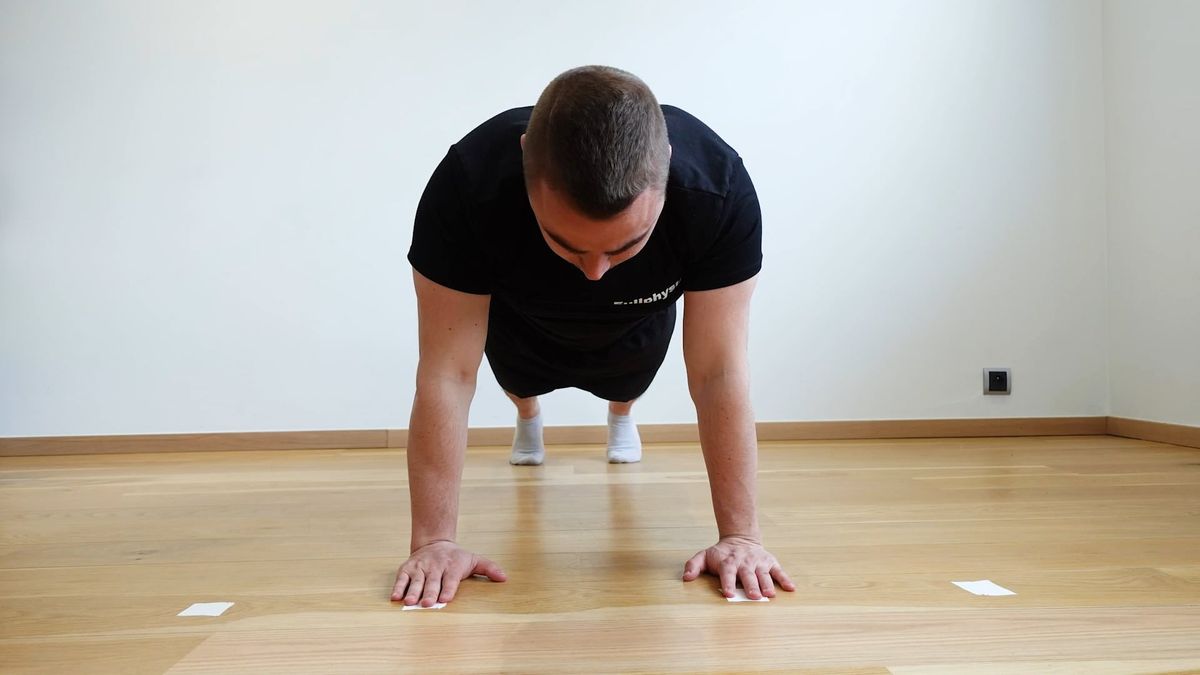
To perform the Modified CKCUEST, the therapist first places two strips of tape on the floor, 91.4 cm (about 36 in) apart and parallel to each other. The subject starts in a push-up position, with the back flat and parallel to the floor, and the hands positioned directly under the shoulders.
This position reflects the modification from the original test, in which the subject began with the hands placed on the two strips of tape. The modified version standardizes upper limb positioning for each subject while accounting for variability across athletic populations.
On the therapist’s signal, the subject begins the test by alternately reaching across to touch each strip of tape with the opposite hand as quickly as possible for 15 seconds. The therapist counts the number of touches completed during this time.
However, at present, the original version of the test appears to be more strongly correlated with isokinetic shoulder strength than the modified test (Lee et al., 2015; Borms and Cools, 2018).
It should be noted that the test can also be performed in a push-up position on the knees if necessary, following the same instructions.
Finally, the modified CKCUEST can also serve as an effective rehabilitation exercise for the shoulder following instability surgery, after dislocation, or in the context of tendinopathy rehabilitation.
Clinical Value
In their 2016 study, Taylor et al. evaluated the CKCUEST in the modified position in 257 male and female collegiate Division I athletes participating in sports such as basketball, football, baseball, and volleyball.
The authors established 25 and 22.9 touches as reference values for male and female subjects, respectively. They noted that their results were comparable to those of previous studies using the original test position. However, they also observed that female participants achieved higher scores in the modified test position compared to the original version. These differences may be related to changes in testing procedures, such as hand placement width or the warm-up included in the original version.
In 2020, Hollstadt et al. concluded, based on their findings, that the CKCUEST in a modified position is a reliable assessment tool. The authors highlighted that this modified position may be advantageous for smaller-framed athletes.
To determine whether an athlete is ready to return to shoulder sports, the choice of testing battery depends on the athlete’s profile (overhead athletes / throwers or contact sports) and, in the latter case, on the direction of the instability (anterior vs. posterior), as illustrated in the mapping proposed by Olds et al. (2024).
In addition to the athlete’s overall profile, the specific selection of return-to-sport tests should also be tailored to the sport in question. Here is the battery of tests recommended by Tooth et al. (2022), broken down by sport:
Bibliography
Borms, Dorien, et Ann Cools. « Upper-Extremity Functional Performance Tests: Reference Values for Overhead Athletes ». International Journal of Sports Medicine 39, no 6 (juin 2018): 433‑41.
Goldbeck TG Davies GJ. Test-retest reliability of the closed kinetic chain upper extremity stability test: a clinical field test. J Sports Rehabil. 2000;9:35-45.
Hollstadt, Kayla, Mark Boland, et Ivan Mulligan. « Test-Retest Reliability of the Closed Kinetic Chain Upper Extremity Stability Test (CKCUEST) in a Modified Test Position in Division I Collegiate Basketball Players ». International Journal of Sports Physical Therapy 15, no 2 (avril 2020): 203‑9.
Jeffrey B., Alexis A. Wright, James M. Smoliga, J. Tyler DePew, et Eric J. Hegedus. « Upper-Extremity Physical-Performance Tests in College Athletes ». Journal of Sport Rehabilitation 25, no 2 (mai 2016): 146‑54.
Lee, Dong-Rour, et Laurentius Jongsoon Kim. « Reliability and validity of the closed kinetic chain upper extremity stability test ». Journal of Physical Therapy Science 27, no 4 (avril 2015): 1071‑73.
Oliveira VMA Pitangui ACR Nascimento VYS et al. Test-retest reliability of the closed kinetic chain upper extremity stability test in adolescents: reliability of CKCUEST in adolescents. Int J Sports Phys Ther. 2017;12:125-132.Taylor,