

Neck Flexor Endurance Test

Contents
Context
The neck flexor endurance test measures how long a patient can hold a craniocervical flexion position (chin tucked) while lifting the head against gravity. It assesses the endurance of the neck flexors as a whole, including the sternocleidomastoid, rather than that of the deep flexors alone; some authors nevertheless call it the Deep Neck Flexor Endurance Test (DNFET; Domenech et al., 2011).
Alterations in muscle function are frequently reported in neck pain, particularly at the level of the neck extensors, as presented in our video on the Cervical Extensor Endurance Test. A deficit in neck flexor endurance has also been reported in people with neck pain (Harris et al., 2005; Jull et al., 2021), but it is not found in all populations (see “Clinical Value”).
The neck flexor muscles, particularly the deep flexors, such as the longus capitis, longus colli, and the anterior and lateral rectus capitis, are thought to assist in stabilizing the cervical spine during significant neck movements.
In people with neck pain, the contribution of the deep flexors may be reduced and the activity of the sternocleidomastoid increased during craniocervical flexion. Their activation may also be delayed during rapid arm movement, more so for the deep than for the superficial flexors, as described by David Colman in the Fullphysio Masterclass on the consequences of neck pain on local muscle activity (2023; in French).
During the initial assessment, it is generally not relevant to directly evaluate the strength and endurance of the cervical muscles. These assessments are more commonly performed during the progression of ongoing rehabilitation, particularly when the patient is able to control the cranio-cervical region in a head lift assessment.
Although many use a dynamometer to evaluate the strength and endurance of the neck flexors (O’Leary et al., 2005; O’Leary et al., 2007), the Head Lift Test is commonly used in clinical practice.
Video of the Test

Execution
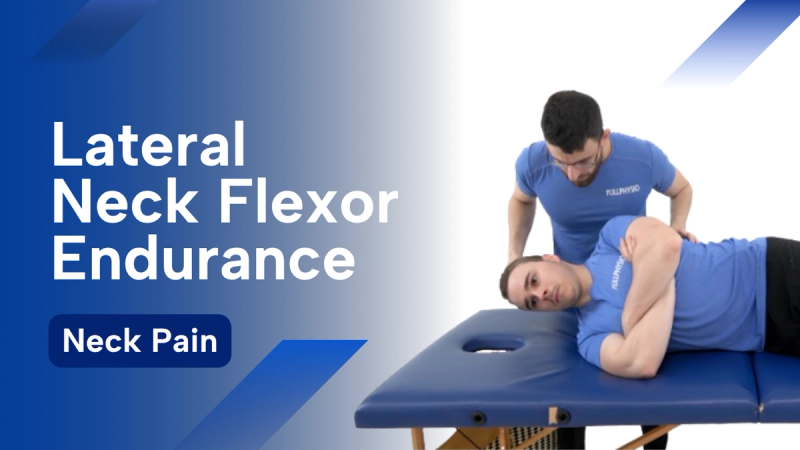
To perform the test, the patient lies on their back with their knees bent and hands resting on their abdomen. The therapist then asks the patient to retract their chin into a chin tuck position and lift their head approximately 2.5 cm above the table. The therapist can place their hand on the table just below the patient's occiput to feel if the patient lowers their head. The stopwatch starts when the patient is in position to measure their ability to maintain a cranio-cervical flexion while performing an active head lift (Juul et al., 2013). Verbal feedback such as “Retract your chin” or “Keep your head up” can be given if the patient starts losing the chin position or if their head touches the examiner’s hand (Edmondston et al., 2008; Childs et al., 2008; Domenech et al., 2011).
The test ends if the patient loses the chin position or if their head touches the therapist's hand for more than one second (Edmondston et al., 2008; Childs et al., 2008). A recent commentary on its use in fighter pilots notes that inter-rater reliability is lower when test termination depends on the examiner's judgment (Acevedo & Zeigler, 2026): recording the protocol used makes it possible to repeat the test under the same conditions.
Lifting the head against gravity engages all the neck flexors, including the sternocleidomastoid (SCM), so the test does not specifically target the deep flexors.
In their 2005 study of 41 participants, Harris et al. found an average score of 38.95 seconds (SD: 26.4) in healthy subjects, while the neck pain group had an average score of 24.1 seconds (SD: 12.8).
Clinical Value
In primary studies, the reliability of the test ranges from moderate to excellent. With the same examiner or between sessions (test-retest): ICC of 0.82 to 0.91 in people without pain (Harris et al., 2005), 0.93 (Edmondston et al., 2008), 0.68 to 0.75 (Juul et al., 2013), and 0.71 (Lourenço et al., 2016). Between examiners it is lower: ICC of 0.67 to 0.78 (Harris et al., 2005), 0.66 (Domenech et al., 2011), and 0.70 to 0.73 (Juul et al., 2013). The systematic review and meta-analysis by Selistre et al. (2021; 31 studies) concludes that reliability is moderate to good (ICC 0.64 to 0.90) for cervical endurance, craniocervical flexion, and dynamometer strength tests, with insufficiently documented concurrent validity (2 studies). In practice, the test is mainly useful for monitoring a patient with the same examiner and the same protocol.
Edmondston et al. (2008) reported a minimal detectable change (MDC) of 17.8 seconds (standard error of measurement: 6.4 s; 21 participants with chronic postural neck pain), and Lourenço et al. (2016) an MDC of 19.15 seconds in students with subclinical neck pain. These two values come from limited samples of different populations (21 participants in Edmondston et al.). Juul et al. (2013), in 33 patients with neck pain and 30 participants without pain, report a smallest detectable change of 40 to 45 seconds, both within and between examiners. In practice, a change smaller than 18 to 19 seconds cannot be distinguished from measurement error, even with the same examiner and an identical protocol; under conditions close to routine practice (a single trial), more than 40 seconds is needed (Juul et al., 2013). Avoid interpreting a variation of a few seconds or comparing times measured by different examiners. We found no minimal clinically important difference (MCID) for this test.
Harris et al. (2005) observed a shorter time in people with neck pain (24.1 seconds; SD: 12.8) than in people without pain (38.95 seconds; SD: 26.4), but the standard deviations are large and the distributions overlap. Juul et al. (2013) also found no significant difference between 33 patients with neck pain and 30 participants without pain, and it was not found in students with subclinical neck pain (Lourenço et al., 2016). In 81 Royal Air Force Typhoon pilots, a population with very long hold times, hold time was not significantly correlated with flight-related neck pain, although the most enduring pilots (over 150 seconds) reported it less often (Magill et al., 2026). We found no diagnostic accuracy study (sensitivity, specificity) for this test: a short time therefore cannot, on its own, establish a muscle deficit or classify a patient as having neck pain, and no threshold is validated.
In adults without pain (Domenech et al., 2011; 126 participants), the mean time is 38.9 seconds (SD: 20.1) in men and 29.4 seconds (SD: 13.7) in women; age (20 to 80 years) and activity level have no significant effect, and variability between individuals is high. In 81 athletes aged 14 to 22 years (Jarman et al., 2017), the means are 35.57 seconds (SD: 10.43) in males and 31.86 seconds (SD: 8.53) in females, with no significant difference between sexes; hold time increases moderately with age (r = 0.40). These means describe groups: they are not thresholds, and a time below the mean does not by itself indicate a deficit.
In clinical practice, patients with neck pain may be unable to perform this test in the supine position due to pain or insufficient muscle strength (Juul et al., 2013; Jull et al., 2021). Therefore, it can be useful to assess neck flexor endurance in various positions where the effects of gravity and head weight are reduced, such as in several seated angles (Jull et al., 2021). The 45° seated version is, however, less reliable (ICC 0.41 to 0.74; smallest detectable change above 97 seconds; Juul et al., 2013): interpret it with caution.
Bibliography
Acevedo, A., & Zeigler, Z. (2026). Improved hold time, unproven benefit: Reassessing the cervical endurance hold as an outcome measure in fighter pilots. Military Medicine. Advance online publication. https://doi.org/10.1093/milmed/usag486
Childs, J. D., Cleland, J. A., Elliott, J. M., Teyhen, D. S., Wainner, R. S., Whitman, J. M., Sopky, B. J., Godges, J. J., & Flynn, T. W. (2008). Neck pain: Clinical practice guidelines linked to the International Classification of Functioning, Disability, and Health from the Orthopedic Section of the American Physical Therapy Association. Journal of Orthopaedic & Sports Physical Therapy, 38(9), A1–A34. https://doi.org/10.2519/jospt.2008.0303
Domenech, M. A., Sizer, P. S., Dedrick, G. S., McGalliard, M. K., & Brismee, J.-M. (2011). The deep neck flexor endurance test: Normative data scores in healthy adults. PM&R, 3(2), 105–110. https://doi.org/10.1016/j.pmrj.2010.10.023
Edmondston, S. J., Wallumrød, M. E., Macléid, F., Kvamme, L. S., Joebges, S., & Brabham, G. C. (2008). Reliability of isometric muscle endurance tests in subjects with postural neck pain. Journal of Manipulative and Physiological Therapeutics, 31(5), 348–354. https://doi.org/10.1016/j.jmpt.2008.04.010
Harris, K. D., Heer, D. M., Roy, T. C., Santos, D. M., Whitman, J. M., & Wainner, R. S. (2005). Reliability of a measurement of neck flexor muscle endurance. Physical Therapy, 85(12), 1349–1355. https://doi.org/10.1093/ptj/85.12.1349
Jarman, N. F., Brooks, T., James, C. R., Hooper, T., Wilhelm, M., Brismée, J.-M., Domenech, M. A., Kotara, S. J., & Sizer, P. S. (2017). Deep neck flexor endurance in the adolescent and young adult: Normative data and associated attributes. PM&R, 9(10), 969–975. https://doi.org/10.1016/j.pmrj.2017.02.002
Jull, G., Falla, D., Treleaven, J., & O’Leary, S. (2021). Prise en charge des cervicalgies.
Juul, T., Langberg, H., Enoch, F., & Søgaard, K. (2013). The intra- and inter-rater reliability of five clinical muscle performance tests in patients with and without neck pain. BMC Musculoskeletal Disorders, 14, 339. https://doi.org/10.1186/1471-2474-14-339
Lourenço, A. S., Lameiras, C., & Silva, A. G. (2016). Neck flexor and extensor muscle endurance in subclinical neck pain: Intrarater reliability, standard error of measurement, minimal detectable change, and comparison with asymptomatic participants in a university student population. Journal of Manipulative and Physiological Therapeutics, 39(6), 427–433. https://doi.org/10.1016/j.jmpt.2016.05.005
Magill, J., Kelly, A., McRobert, C., & Slungaard, E. (2026). Relationship between neck flexor endurance and flight-related neck pain in Typhoon pilots. Aerospace Medicine and Human Performance, 97(7), 478–487. https://doi.org/10.3357/amhp.6564.2026
O’Leary, S. P., Vicenzino, B. T., & Jull, G. A. (2005). A new method of isometric dynamometry for the craniocervical flexor muscles. Physical Therapy, 85(6), 556–564.
O’Leary, S., Falla, D., Jull, G., & Vicenzino, B. (2007). Muscle specificity in tests of cervical flexor muscle performance. Journal of Electromyography and Kinesiology, 17(1), 35–40.
Selistre, L. F. A., Melo, C. de S., & Noronha, M. A. de. (2021). Reliability and validity of clinical tests for measuring strength or endurance of cervical muscles: A systematic review and meta-analysis. Archives of Physical Medicine and Rehabilitation, 102(6), 1210–1227. https://doi.org/10.1016/j.apmr.2020.11.018