Resources
Stay informed
Royal London Hospital Test (Patellar)
Contents
Test protocol
Context
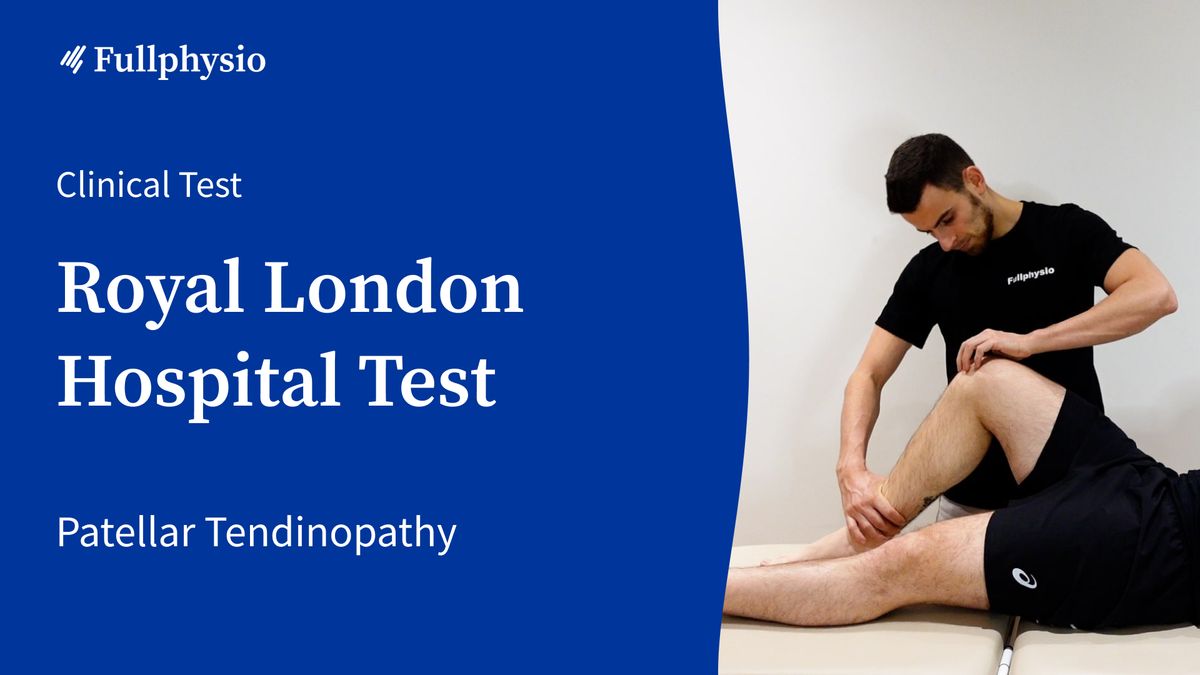
The Royal London Hospital Test may aid in the diagnosis of patellar tendinopathy.
Patellar tendinopathy (PT), also known as “jumper’s knee,” is commonly seen in sports involving running and jumping (Figueroa et al., 2016). It is an overuse injury resulting from the repeated extension of the knee (van Ark et al., 2016).
The key to an accurate clinical diagnosis lies in a well-localized (focal) complaint at the attachment of the patellar tendon to the patella. On clinical examination, symptoms are typically exacerbated during high-energy-storage activities involving the knee extensors, such as jumping, changes of direction, sprinting, etc. In their 2017 study, Maffuli et al. sought to determine whether the Royal London Hospital Test was reproducible, sensitive, and specific for the diagnosis of patellar tendinopathy.
Video of the Test
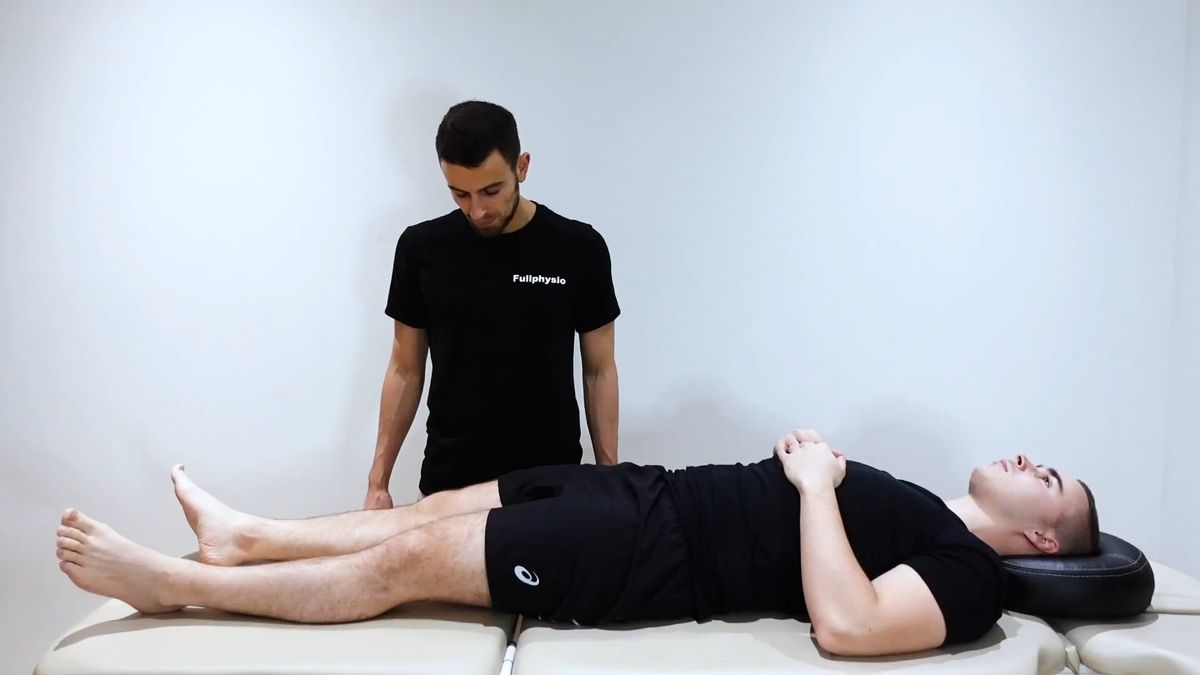
Execution
To perform this test, the patient lies on their back with their knees straight, and the therapist palpates the tendon to check for local tenderness. The therapist then palpates the sensitive area of the tendon again with the knee flexed to 90°. The test is considered positive if the pain is significantly reduced or absent when the knee is flexed. The reason why tensioning the tendon causes a reduction in symptoms is unknown.
Clinical Value
Maffuli et al. (2017) report that in symptomatic patients with PT, the Royal London Hospital Test showed lower sensitivity (88% vs. 98%) and higher specificity (98% vs. 94%) than manual palpation (Aicale et al., 2020).
In this study, the Manual Palpation Test had a much higher clinical value than that found by Cook et al. in their 2001 study. This could be explained in part by the difference in the definition of ultrasound-detected tendinopathy between the two studies.
Maffuli et al. recommend that clinicians perform both tests for a correct clinical diagnosis of PT tendinopathy. They emphasize that a positive Palpation Test alone may not necessarily be associated with patellar tendinopathy, whereas positivity in both clinical tests is strongly associated with the presence of patellar tendinopathy on ultrasound.
In everyday practice, it is important to keep in mind that imaging is not considered necessary for a clinical diagnosis of tendinopathy (Scott et al., 2020).
Bibliography
Aicale, R., Oliviero, A., & Maffulli, N. (2020). Management of Achilles and patellar tendinopathy : What we know, what we can do. Journal of Foot and Ankle Research, 13, 59.
Cook, J. L., K. M. Khan, Z. S. Kiss, C. R. Purdam, et L. Griffiths. « Reproducibility and Clinical Utility of Tendon Palpation to Detect Patellar Tendinopathy in Young Basketball Players. Victorian Institute of Sport Tendon Study Group ». British Journal of Sports Medicine 35, no 1 (février 2001): 65‑69.
Figueroa, David, Francisco Figueroa, et Rafael Calvo. « Patellar Tendinopathy: Diagnosis and Treatment ». The Journal of the American Academy of Orthopaedic Surgeons 24, nᵒ 12 (décembre 2016): e184‑92.
Maffulli, Nicola, Francesco Oliva, Mattia Loppini, Rocco Aicale, Filippo Spiezia, et John B King. « The Royal London Hospital Test for the clinical diagnosis of patellar tendinopathy ». Muscles, Ligaments and Tendons Journal 7, no 2 (18 septembre 2017): 315‑22.
Scott, Alex, Kipling Squier, Hakan Alfredson, Roald Bahr, Jill L. Cook, Brooke Coombes, Robert-Jan de Vos, et al. « ICON 2019: International Scientific Tendinopathy Symposium Consensus: Clinical Terminology ». British Journal of Sports Medicine 54, no 5 (mars 2020): 260‑62.