Resources
Stay informed
Selfie Test

Contents
Test protocol
Context
During the clinical examination, localized tenderness at the origin of the extensor carpi radialis brevis is generally observed. Symptoms are often reproduced by provocation tests (Ahmed et al., 2022). These tests are based on passive stretching of the common extensor or active recruitment of these muscles.
The most widely accepted and commonly used tests are Cozen’s, Mill’s, and Maudsley’s tests (Pienimäki et al., 2002).
Although the literature is limited regarding the accuracy of these tests in diagnosing LE, a systematic review by Karanasios et al. in 2021 found that Cozen’s test had the highest sensitivity at 91%, followed by Mill’s test at 76% and Maudsley’s test at 70%. However, the specificity of these tests is generally low, ranging from 3% to 13%.
In 2023, Factor and colleagues proposed a new clinical test: the Selfie Test.
Video of the Test
Execution
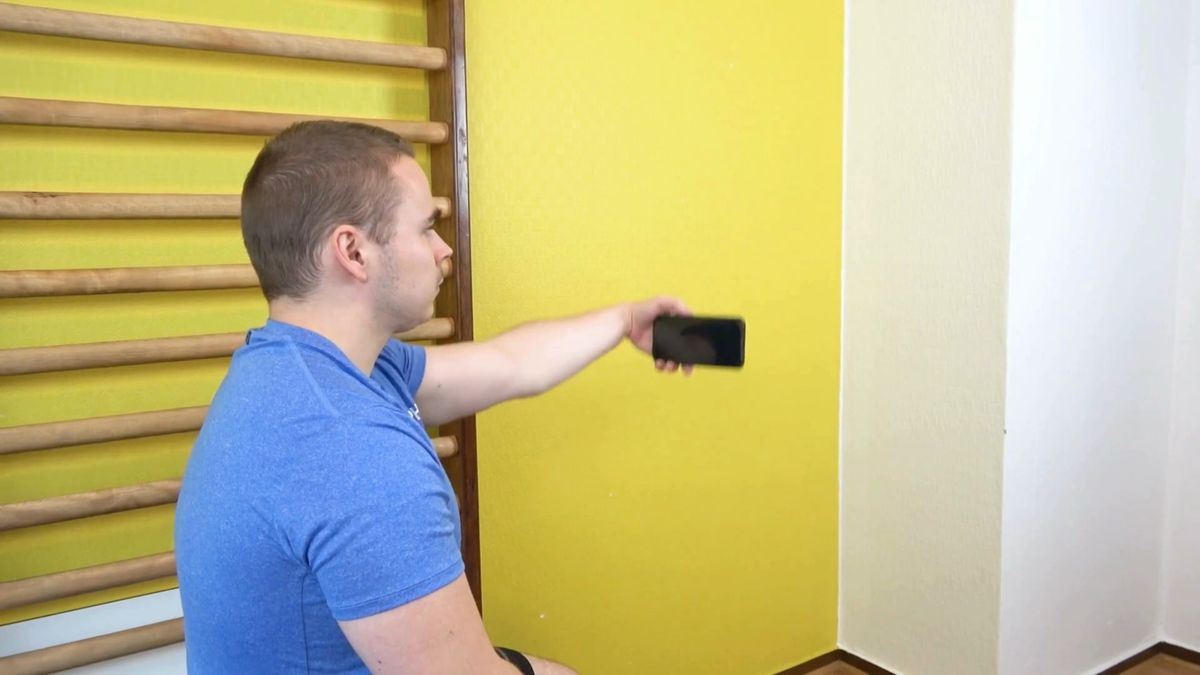
To perform this test, the patient is seated or standing, holding a mobile phone with the elbow fully extended. They are instructed to flex the wrist and independently press either the screen or the top button with the thumb (simulating the action of taking a selfie). Pain on the lateral aspect of the elbow joint indicates a positive test.
Clinical Value
The authors reported that the Selfie Test demonstrated a high sensitivity of 93% and a positive predictive value (PPV) of 93%. They concluded that the active nature of the Selfie Test, which allows patients to perform the assessment themselves, could be a valuable addition to the diagnostic process, potentially improving the accuracy of tennis elbow diagnosis.
It is important to note that although this test appears to add value to the physical examination, it remains the only study to have evaluated the test to date (Factor et al., 2023; Santilli et al., 2024). The validity of this test must also be taken into account, as ultrasound is still used as the reference standard. However, it is well known that degenerative changes can be observed in asymptomatic patients. Furthermore, how can we be certain that nerve compression or another pathological entity is not causing the patient’s symptoms? This is why a comprehensive assessment of the elbow, shoulder, and cervical spine is strongly recommended when a patient presents with lateral elbow pain.
Bibliography
Ahmed A.F., Rayyan R., Zikria B.A., Salameh M. Lateral epicondylitis of the elbow: An up-to-date review of management. Eur. J. Orthop. Surg. Traumatol. 2022;33:201–206.
Factor, Shai, Pablo Gabriel Snopik, Assaf Albagli, Ehud Rath, Eyal Amar, Franck Atlan, et Guy Morag. « The “Selfie Test”: A Novel Test for the Diagnosis of Lateral Epicondylitis ». Medicina 59, no 6 (16 juin 2023): 1159.
Karanasios S., Korakakis V., Moutzouri M., Drakonaki E., Koci K., Pantazopoulou V., Tsepis E., Gioftsos G. Diagnostic accuracy of examination tests for lateral elbow tendinopathy (LET)—A systematic review. J. Hand Ther. 2021;35:541–551.
Pienimäki T., Tarvainen T., Siira P., Malmivaara A., Vanharanta H. Associations between pain, grip strength, and manual tests in the treatment evaluation of chronic tennis elbow. Clin. J. Pain. 2002;18:164–170.
Santilli, G., Ioppolo, F., Mangone, M., Agostini, F., Bernetti, A., Forleo, S., Cazzolla, S., Mannino, A. C., Fricano, A., Franchitto, A., Taurone, S., Ciccarelli, A., & Paoloni, M. (2024). High Versus Low-Energy Extracorporeal Shockwave Therapy for Chronic Lateral Epicondylitis : A Retrospective Study. Journal of Functional Morphology and Kinesiology, 9(3), 173.