Resources
Stay informed
Supine Plank Test
Contents
Test protocol
Context
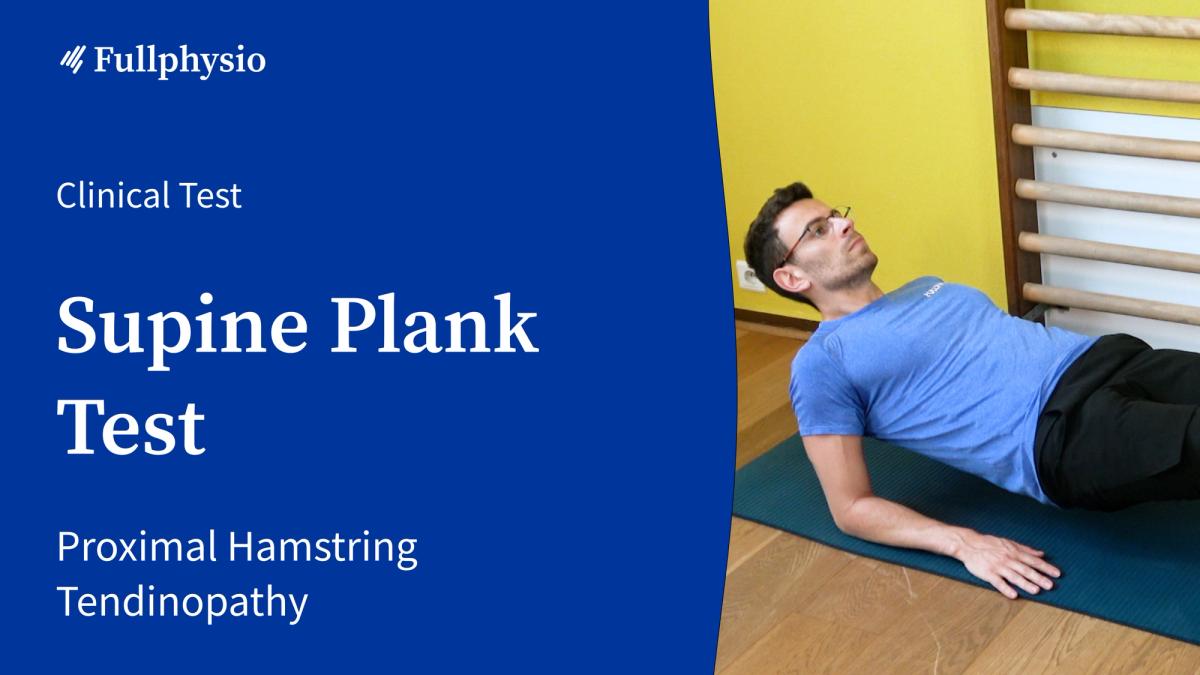
We will talk about the Supine Plank Test, a test that can be used to help diagnose proximal hamstring (HS) tendinopathy.
On Fullphysio, we have a Module dedicated to proximal HS tendinopathy. For this condition, several diagnostic tests have been proposed. We have also produced a video covering the three main tests: the Puranen-Orava Test, the Bent-Knee Stretch Test, and the Modified Bent-Knee Stretch Test.
There are, of course, other tests, such as the Supine Plank Test. However, our research identified only one study, by Fredericson, specifically describing this test for assessing HS strength.
More recently, a 2024 study conducted by Campos-Villegas and colleagues also included the Supine Plank Test in their physical examination. However, interestingly, they did not provide the same description as that of the source they cited.
Video of the Test

Execution
According to Fredericson’s study, the patient lifts the pelvis while supporting body weight on the elbows and heels. The legs are then lifted alternately, starting with the injured leg (thus testing the uninjured leg first). Pelvic drop or rotation, or pain at the hamstring origin during elevation of the contralateral leg, indicates hamstring weakness and, therefore, a positive test.
However, Campos-Villegas et al. describe the test with the arms extended and the fingers pointing backward, despite citing the study by Fredericson et al.
Clinical Value
In the same study (Campos-Villegas et al., 2024), the authors indicate that an acute strain is suggested by positive findings on three tests: tenderness to palpation, a positive Bent-Knee Stretch Test, and a positive Supine Plank Test.
They add that these findings may also indicate an exacerbation of an underlying chronic injury.
Conversely, the absence of significant palpable tenderness may suggest a more subacute injury, likely associated with underlying fibrosis or scarring.
Despite these recommendations, we did not identify any studies evaluating the validity and reliability of the Supine Plank Test. Nevertheless, this test can be incorporated into a battery of other tests and may also serve as a marker of progress to be reassessed throughout rehabilitation.
Bibliography
Campos-Villegas, Cristina, Lucía Ortega-Pérez de Villar, Javier Gámez-Payá, Jorge Alarcón-Jiménez, et Nieves de Bernardo. « Clinical Progression and Load Management For Proximal Hamstring Tendinopathy In A Long-Distance Runner: A Case Report ». International Journal of Sports Physical Therapy 19, no 5 (s. d.): 609‑17.
Fredericson, Michael, William Moore, Marc Guillet, et Christopher Beaulieu. « High Hamstring Tendinopathy in Runners: Meeting the Challenges of Diagnosis, Treatment, and Rehabilitation ». The Physician and Sportsmedicine 33, no 5 (mai 2005): 32‑43.