Resources
Stay informed
Table-top Relocation Test

Contents
Test protocol
Context
Posterolateral rotatory instability (PLRI) of the elbow is the most common form of recurrent instability of this joint. It was first described in 1991 by O’Driscoll and colleagues. This condition most often results from a rupture of the lateral ulnar collateral ligament (LUCL), which may occur after significant trauma, such as a fall on an outstretched arm, leading to dislocation of the radius on the capitulum (O’Driscoll et al., 1991; Ling et al., 2024).
Damage to the LUCL may also be iatrogenic, such as from repeated corticosteroid injections for the treatment of lateral epicondylitis or from surgical procedures in which the LUCL was not adequately repaired.
Conditions such as radial head resection or chronic ulnar varus following a prior distal humeral fracture may also lead to PLRI (Cheung et al., 2008; Charalambous et al., 2008; Dzugan et al., 2012; Kalainov et al., 2005; Hall et al., 2005).
Although injury to the LUCL was initially identified as the main cause of PLRI, subsequent research has shown that damage to other elbow soft-tissue structures is also necessary for this instability to develop (Dunning et al., 2001; McAdams et al., 2004; Seki et al., 2002).
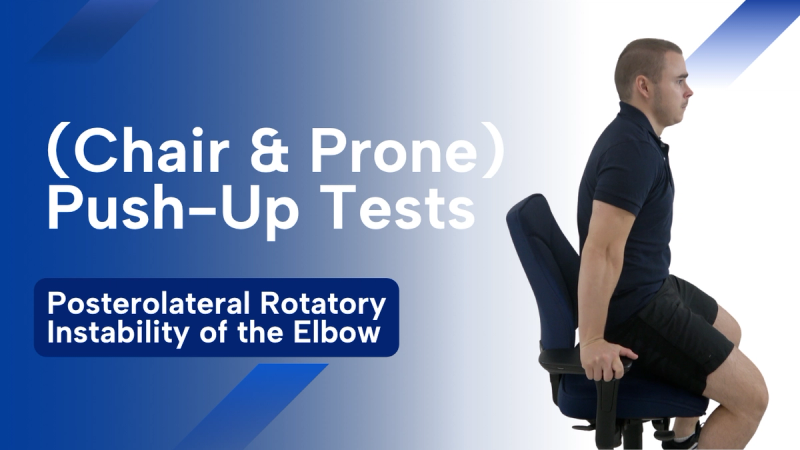
Patients with PLRI often experience pain on the lateral side of the elbow, especially when performing movements that extend and supinate the elbow, such as pushing up from the arms of a chair or doing push-ups. Lateral elbow pain may be accompanied by mechanical symptoms such as clicking, catching, or a more pronounced clunk at 40° of flexion when the arm is in extension (Anakwenze et al., 2013).
Video of the Test

Execution
To perform the test, ask the patient to assume a push-up position, with the hands placed well apart and the forearms in supination. The patient should lower into the push-up as far as possible, keeping the elbows at the sides. At around 40° of flexion, patients with posterolateral instability often experience pain or apprehension.
While the patient is in the weight-bearing position, position yourself over the epicondyle and move down to the radial head. Use a broad contact surface of your thumb over the radius, with a full-hand grip if possible. Apply a posteroanterior mobilization and ask the patient to repeat the movement and then push back up. This maneuver is intended to reduce symptoms such as pain or apprehension.
The findings are confirmed if the patient again reports pain or apprehension when returning to the symptomatic range after the pressure on the radial head is released.
Clinical Value
In 2006, Arvind and Hargreaves evaluated the Table-Top Relocation Test, demonstrating 100% sensitivity but unknown specificity. However, it has been suggested that this test is theoretically more specific than the Chair Push-Up Test and Prone Push-Up Test because relieving apprehension would make intra-articular pathology less likely to cause symptoms (Arvind and Hargreaves, 2006; Karbach and Elfar, 2017).
Bibliography
Anakwenze, O. A., Kancherla, V. K., Iyengar, J., Ahmad, C. S., & Levine, W. N. (2014). Posterolateral rotatory instability of the elbow. The American Journal of Sports Medicine, 42(2), 485‑491.
Arvind, C., & Hargreaves, D. (2006). Tabletop relocation test : A new clinical test for posterolateral rotatory instability of the elbow. Journal of shoulder and elbow surgery / American Shoulder and Elbow Surgeons, 15, 707‑708.
Charalambous, C. P., et J. K. Stanley. « Posterolateral Rotatory Instability of the Elbow ». The Journal of Bone and Joint Surgery. British Volume 90, no 3 (mars 2008): 272‑79.
Cheung, Emilie V. « Chronic Lateral Elbow Instability ». The Orthopedic Clinics of North America 39, no 2 (avril 2008): 221‑28, vi‑vii.
Cohen, M. S., et H. Hastings. « Rotatory Instability of the Elbow. The Anatomy and Role of the Lateral Stabilizers ». The Journal of Bone and Joint Surgery. American Volume 79, no 2 (février 1997): 225‑33.
Dunning, C. E., Z. D. Zarzour, S. D. Patterson, J. A. Johnson, et G. J. King. « Ligamentous Stabilizers against Posterolateral Rotatory Instability of the Elbow ». The Journal of Bone and Joint Surgery. American Volume 83, no 12 (décembre 2001): 1823‑28.
Dzugan, Sergey S., Felix H. Savoie, Larry D. Field, Michael J. O’Brien, et Zongbing You. « Acute Radial Ulno-Humeral Ligament Injury in Patients with Chronic Lateral Epicondylitis: An Observational Report ». Journal of Shoulder and Elbow Surgery 21, no 12 (décembre 2012): 1651‑55.
Fedorka, Catherine J., et Luke S. Oh. « Posterolateral rotatory instability of the elbow ». Current Reviews in Musculoskeletal Medicine 9, no 2 (18 mai 2016): 240‑46.
Goodwin, David, Maria Dynin, J. Ryan Macdonnell, et Michael W. Kessler. « The Role of Arthroscopy in Chronic Elbow Instability ». Arthroscopy: The Journal of Arthroscopic & Related Surgery: Official Publication of the Arthroscopy Association of North America and the International Arthroscopy Association 29, no 12 (décembre 2013): 2029‑36.
Hall, Jeremy A., et Michael D. McKee. « Posterolateral Rotatory Instability of the Elbow Following Radial Head Resection ». The Journal of Bone and Joint Surgery. American Volume 87, no 7 (juillet 2005): 1571‑79.
Kalainov, David M., et Mark S. Cohen. « Posterolateral Rotatory Instability of the Elbow in Association with Lateral Epicondylitis. A Report of Three Cases ». The Journal of Bone and Joint Surgery. American Volume 87, no 5 (mai 2005): 1120‑25.
Karbach, L. E., & Elfar, J. (2017). Elbow Instability : Anatomy, Biomechanics, Diagnostic Maneuvers, and Testing. The Journal of Hand Surgery, 42(2), 118.
Ling, C. T., Durrant, A. W., Foster, M., Wang, A., Rahman, J., & Heiss-Dunlop, W. (2024). A clinical review of elbow ligament repairs and reconstructions in the acute and chronic settings. JSES International, 8(4), 903.
O’Driscoll, S. W., D. F. Bell, et B. F. Morrey. « Posterolateral Rotatory Instability of the Elbow ». The Journal of Bone and Joint Surgery. American Volume 73, no 3 (mars 1991): 440‑46.
O’Driscoll, S. W., B. F. Morrey, S. Korinek, et K. N. An. « Elbow Subluxation and Dislocation. A Spectrum of Instability ». Clinical Orthopaedics and Related Research, no 280 (juillet 1992): 186‑97.
Seki, Atsuhito, Bo Sanderhoff Olsen, Steen Lund Jensen, Denise Eygendaal, et Jens Ole Søjbjerg. « Functional Anatomy of the Lateral Collateral Ligament Complex of the Elbow: Configuration of Y and Its Role ». Journal of Shoulder and Elbow Surgery 11, no 1 (2002): 53‑59.