Resources
Stay informed
Thompson Test
Contents
Test protocol
Context
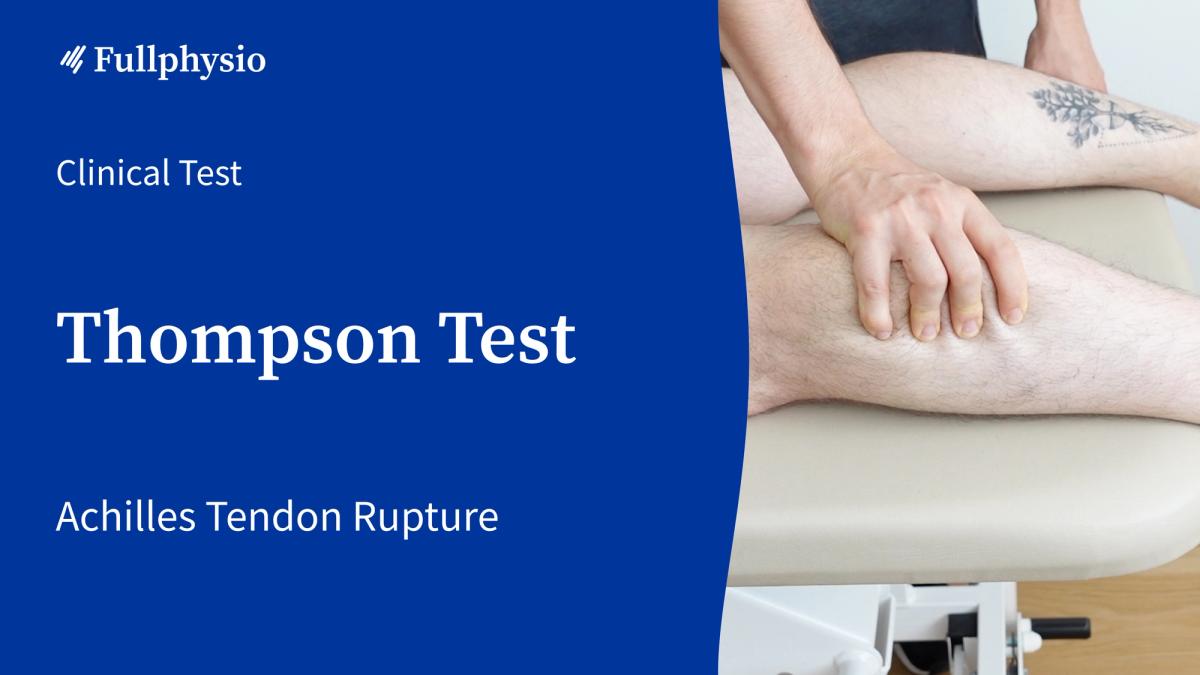
The Calf Squeeze Test or Thompson Test is commonly used to diagnose Achilles tendon rupture (Silvers et al., 2020).
The diagnosis of acute rupture of the Achilles tendon is based primarily on a thorough clinical history and physical examination. Some surgeons, such as Ronny Lopes from Nantes (France), claim that the diagnosis of a total rupture of the Achilles tendon is clinical and that no imaging is necessary, not even ultrasound.
Typically, patients with an acute rupture of the tendon often describe hearing a snapping sound in the back of the leg, or having the sensation of having been kicked in the back of the ankle (Park et al., 2020).
Video of the Test

Execution
During the physical examination, the Thompson Test is performed with the patient prone on the examination table, feet off the table. The therapist cups the calf in their palm just below the area of maximum circumference and applies compression. If the Achilles tendon is intact, we observe a plantar flexion movement. On the contrary, if the tendon has completely ruptured, the foot will not move into plantar flexion. The video above shows a positive Thompson Test performed by Ronny Lopes just before surgery.
Clinical Value
In 1998, Maffulli gave the test a sensitivity of 0.96 and a specificity of 0.93 for diagnosing Achilles tendon rupture. A false negative for this test is more likely in the case of a neglected rupture in which the hematoma has been replaced by healing tendon tissue. In their 2014 systematic review and meta-analysis, Reiman et al. reported that this test had a positive likelihood ratio of 13.51 and a negative likelihood ratio of 0.04, making it possible to exclude or admit an Achilles tendon tear to a “significant and almost conclusive degree.”
It is important to remember that, in the event of an Achilles tendon rupture, the deep plantar flexors of the foot generally remain intact. This would allow some degree of plantar flexion strength (Ralston et al., 1971). Furthermore, in their 2015 study, Cuttica et al. indicate that it may not be a useful test for diagnosing partial Achilles tendon ruptures, which would require further diagnostic imaging studies.
It has also been suggested that the ultrasound-guided Thompson Test would be more sensitive and specific than static ultrasound for the assessment and diagnosis of acute Achilles tendon rupture with minimal ultrasound experience (Griffin et al., 2017).
Bibliography
Cuttica, Daniel J., Christopher F. Hyer, et Gregory C. Berlet. « Intraoperative Value of the Thompson Test ». *The Journal of Foot and Ankle Surgery: Official Publication of the American College of Foot and Ankle Surgeons* 54, no 1 (février 2015): 99‑101.
Griffin, M. J., Olson, K., Heckmann, N., & Charlton, T. P. (2017). Realtime Achilles Ultrasound Thompson (RAUT) Test for the Evaluation and Diagnosis of Acute Achilles Tendon Ruptures. Foot & Ankle International, 38(1), 36‑40. (https://doi.org/10.1177/1071100716669983)
Maffulli, N. « The Clinical Diagnosis of Subcutaneous Tear of the Achilles Tendon. A Prospective Study in 174 Patients ». *The American Journal of Sports Medicine* 26, no 2 (avril 1998): 266‑70.
Park, Seung-Hwan, Ho Seong Lee, Ki Won Young, et Sang Gyo Seo. « Treatment of Acute Achilles Tendon Rupture ». *Clinics in Orthopedic Surgery* 12, no 1 (mars 2020): 1‑8.
Ralston, E. L., et E. R. Schmidt. « Repair of the Ruptured Achilles Tendon ». *The Journal of Trauma* 11, no 1 (janvier 1971): 15‑21.
Reiman, Michael, Ciara Burgi, Eileen Strube, Kevin Prue, Keaton Ray, Amanda Elliott, et Adam Goode. « The Utility of Clinical Measures for the Diagnosis of Achilles Tendon Injuries: A Systematic Review with Meta-Analysis ». *Journal of Athletic Training* 49, no 6 (décembre 2014): 820‑29.
Silvers, C. A., Lowe, R., & Cortez, E. (2020). A Step in the Right Direction : Point-of-Care Ultrasound as an Evaluation Tool of Achilles Tendon Injuries in the Emergency Department. Cureus, 12(12), e11823.