Resources
Stay informed
Gillet Test

Contents
Test protocol
Context
Low back pain is a very common condition affecting many people, with a lifetime prevalence estimated at approximately 75% to 84%. Unfortunately, standardized care for patients with low back pain remains controversial due to the multifactorial causes that can give rise to this condition and the lack of diagnostic consensus.
One potential cause of low back pain is sacroiliac joint dysfunction. It is estimated to be associated with non-specific low back pain in approximately 15% of cases (Bogduk et al., 1995; O’Sullivan et al., 2005; Ramdas et al., 2018; Jones and Yoshida, 2021).
The Gillet Test, or Stork Test, is therefore used to assess potential mobility dysfunction of the sacroiliac joint.
Video of the Test
Execution
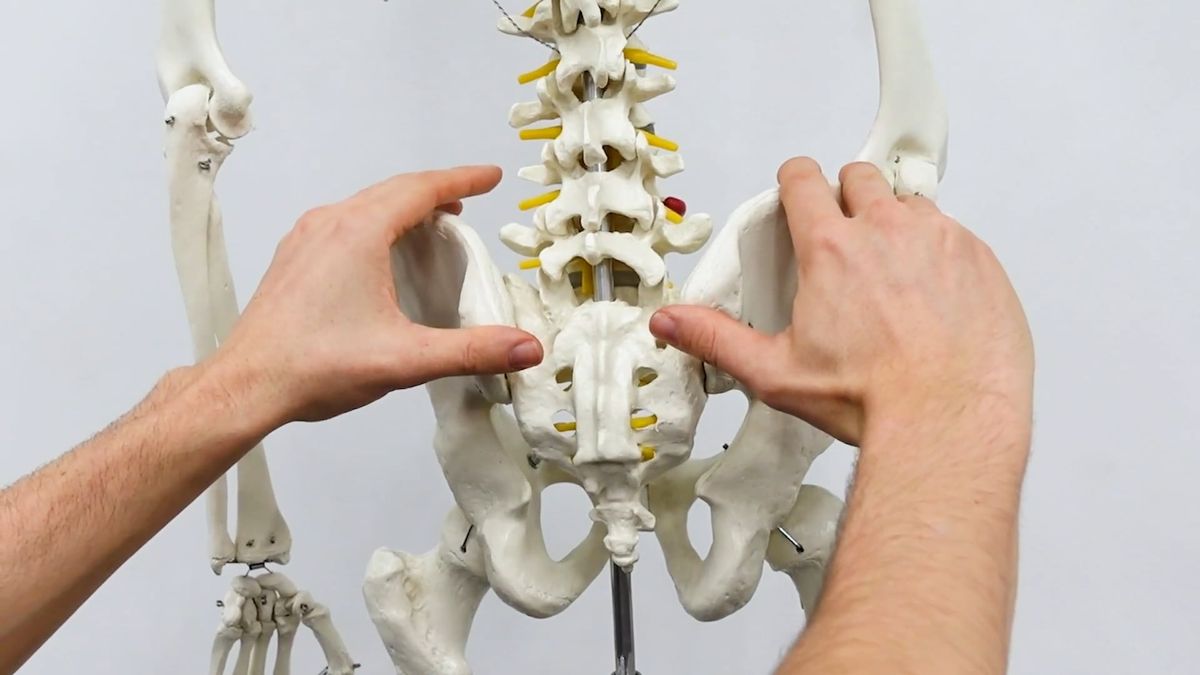
To perform the test, the patient stands with their feet 30 cm apart. The examiner stands behind the patient and locates both posterior superior iliac spines (PSIS) with their thumbs. The spinous process of S2 should be found between the two PSISs.
To test the right sacroiliac joint, the physical therapist places their left thumb on the spinous process of S2 while keeping their right thumb on the right PSIS. The patient then flexes the hip and knee to 90° on the right side. In a healthy individual, the right thumb should move lower than the left, given that a right hip flexion will cause posterior pelvic tilt and, therefore, a downward movement of the right PSIS. If the sacroiliac joint is blocked or hypomobile, the physical therapist will observe little or no movement of the right PSIS.
Clinical Value
Sturesson et al. conducted a series of scientific studies suggesting that sacroiliac joint movement was so small that examiners performing the Gillet Test would not be able to detect it—not even in subjects with sacroiliac joint dysfunction syndrome, who were expected to present with joint hypermobility (Sturesson et al., 2000).
A review article on three-dimensional sacroiliac movement measurements reached a similar conclusion in 2008 (Goode et al., 2008).
In a study examining the impact of palpator experience on the inter-examiner reliability of sacroiliac joint movement assessment (Mior et al., 1990), investigators included, without the palpators’ knowledge, two cases of ankylosing spondylitis. The fact that no palpator identified either sacroiliac joint as fixed in these subjects also called into question the validity of the Gillet Test.
In light of these studies, some manual physical therapists have proposed abandoning this test altogether for investigating the sacroiliac joint (Hungerford et al., 2004).
They suggest reorganizing the test as a qualitative indicator of sacroiliac joint stability, as reflected by the subject’s ability to maintain effective balance in a single-leg stance position (Hungerford et al., 2007; Tidstrand et al., 2009).
In 2018, Cooperstein and colleagues concluded that the results of the Gillet Test could be skewed by the subject’s balancing strategy during a single-leg stance. These different single-leg balancing strategies would be consistent with differences in activation of the gluteus medius and left and right biceps femoris muscles observed in asymptomatic patients. This could result in an apparent relative displacement of the PSIS in relation to S2, even though the Gillet Test findings could be explained in whole or in part by pelvic tilting caused by muscle asymmetry. In summary, Cooperstein et al. call into question the validity of the standing Gillet Test for assessing sacroiliac mobility.
Finally, in their 2020 study, Nejati and colleagues concluded that joint hypomobility leading to a positive test did not necessarily mean that a patient had sacroiliac joint dysfunction. They suggest that a combination of physical tests, in addition to patient history findings and clinical data, could compensate for the low diagnostic power of these tests and would, therefore, be more useful.
Bibliography
Bogduk N: The anatomical basis for spinal pain syndromes. J Manipulative Physiol Ther, 1995, 18: 603–605.
Cooperstein, Robert, et Felisha Truong. « Does the Gillet test assess sacroiliac motion or asymmetric one-legged stance strategies? » The Journal of the Canadian Chiropractic Association 62, no 2 (août 2018): 85‑97.
Goode, Adam, Eric J. Hegedus, Philip Sizer, Jean-Michel Brismee, Alison Linberg, et Chad E. Cook. « Three-Dimensional Movements of the Sacroiliac Joint: A Systematic Review of the Literature and Assessment of Clinical Utility ». The Journal of Manual & Manipulative Therapy 16, no 1 (2008): 25‑38.
Hungerford, Barbara A, Wendy Gilleard, Michael Moran, et Cathryn Emmerson. « Evaluation of the Ability of Physical Therapists to Palpate Intrapelvic Motion With the Stork Test on the Support Side ». Physical Therapy 87, no 7 (1 juillet 2007): 879‑87.
Hungerford, Barbara, Wendy Gilleard, et Diane Lee. « Altered Patterns of Pelvic Bone Motion Determined in Subjects with Posterior Pelvic Pain Using Skin Markers ». Clinical Biomechanics (Bristol, Avon) 19, no 5 (juin 2004): 456‑64.
Jones, B. M., & Yoshida, Y. (2021). Examination of the innominate movements in individuals with and without a positive march test. Journal of Physical Therapy Science, 33(8), 596‑600. (https://doi.org/10.1589/jpts.33.596)
Mior, S. A., M. McGregor, et B. Schut. « The Role of Experience in Clinical Accuracy ». Journal of Manipulative and Physiological Therapeutics 13, no 2 (février 1990): 68‑71.
Nejati, Parisa, Elham Sartaj, Farnad Imani, Reza Moeineddin, Lida Nejati, et Marta Safavi. « Accuracy of the Diagnostic Tests of Sacroiliac Joint Dysfunction ». Journal of Chiropractic Medicine 19, no 1 (mars 2020): 28‑37.
O’Sullivan P: Diagnosis and classification of chronic low back pain disorders: maladaptive movement and motor control impairments as underlyingmechanism. Man Ther, 2005, 10: 242–255.
Ramdas J, Jella V: Prevalence and risk factors of low back pain. Int J Adv Med, 2018, 5: 1120.
Sturesson, B., Uden, A., & Vleeming, A. (2000). A radiostereometric analysis of movements of the sacroiliac joints during the standing hip flexion test. Spine, 25(3), 364‑368.
Tidstrand, Johan, et Eva Horneij. « Inter-Rater Reliability of Three Standardized Functional Tests in Patients with Low Back Pain ». BMC Musculoskeletal Disorders 10 (2 juin 2009): 58.