Resources
Stay informed
Slump Test
Contents
Test protocol
Context
The Slump Test was originally used to assess the mechanosensitivity of neuromeningeal structures in the spinal canal. From 1881, Lazarevic described the possibility of reproducing the patient’s sciatica in a seated position by extending the knee on the painful side (Drača et al., 2015). The Slump Test itself was proposed in the 1980s (Maitland et al., 1985; Koury et al., 1994) and was quickly adopted thanks to its very good intra- and even inter-observer reproducibility (k = 0.83 to 0.89) (Philip et al., 1989), comparable to that of the Lasègue Test (Flavell et al., 2016).
Previous studies have indeed demonstrated that the Slump Test has diagnostic utility in differentiating between neural and non-neural structures. The test consists of several steps involving progressive tensioning of neural tissue. After each step, the therapist will ask the patient if they feel any familiar pain in the lower limb. This may be a burning sensation, numbness, or a shooting pain.
Video of the Test

Execution
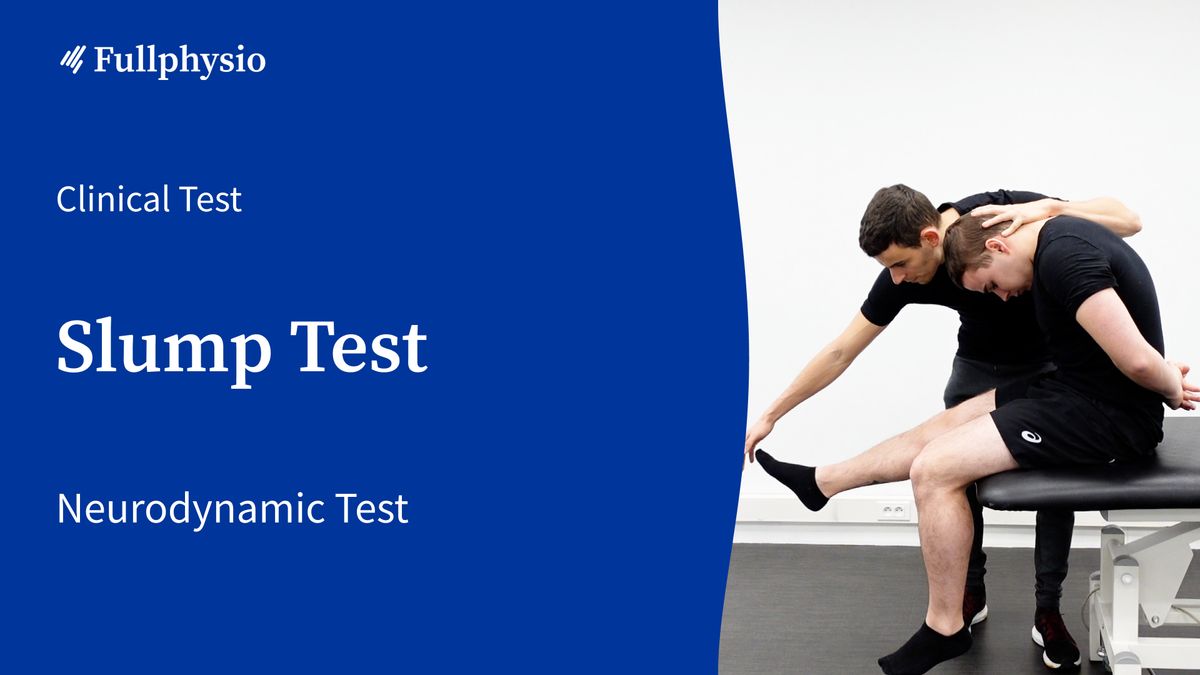
To perform the test, the patient begins seated at the end of the table, knees bent at 90°, back straight, and looking straight ahead.
First, we ask the patient to position their hands behind their back so as to keep the lumbar spine in a neutral position.
The first step is to ask the patient to slump, i.e., to flex the back at the thoracic and lumbar level by performing a posterior pelvic tilt, while keeping the head upright.
If the position does not awaken the symptoms, the therapist applies gentle pressure on the patient’s shoulders. The next step is to ask the patient to bring their chin to their chest.
If, at this stage, the patient still feels no familiar pain, the therapist can add a slight overpressure to the cervical flexion.
For the next step, the therapist asks the patient to elevate their leg.
Finally, to put maximum tension on the nerve structures, the physical therapist can add a dorsiflexion of the patient’s ankle. Of course, it will not be necessary to go this far if the patient’s symptoms rapidly increase.
When the characteristic symptom appears, ask the patient to relax the cervical flexion (or reduce the dorsiflexion of the ankle). If the symptom diminishes or disappears, a neural origin is likely; if it persists unchanged, a non-neural origin (myofascial, joint) is more likely. This maneuver is essential for interpreting the test and significantly improves its inter-rater reliability (κ = 0.85; Pesonen et al., 2021).
Clinical Value
One study examined 34 African patients with lumbar radicular pain who underwent MRI for suspected disc herniation, and in whom a Lasègue Test and a Slump Test were performed. Using the presence of a disc herniation consistent with radicular pain as a reference, the study concluded that the Lasègue Test was slightly more sensitive than the Slump Test (87.5% vs. 80%), but the Slump Test was more specific (71.4% vs. 42.9%) (M’Kumbuzi et al., 2012).
By contrast, a Turkish study examined 75 patients with low back pain or lumbar radicular pain, 38 of whom had a disc herniation on MRI. In this study, the Slump Test was more sensitive in confirming the presence of a disc herniation (84%) than the Straight Leg Raise (SLR) (52%), and their specificity was similar (83% vs. 89%) (Majilesi et al., 2008).
The same was true in a cohort of 99 Swedish patients with sciatica, whose mean age was 59, and all of whom had a disc herniation on MRI. The most frequent sign was a positive Slump Test in 67/99 patients, while the SLR was positive in only 50/99 patients (Ekedahl et al., 2018).
Based on the findings of González et al. in 2020, no single test appears to have sufficient clinical utility when performed individually, and a combination of tests is therefore recommended. Only the combination of the Slump Test and Déjerine triad (coughing, sneezing, and defecation) demonstrated both internal and external validity. This conclusion is consistent with the systematic review by Petersen, Laslett, and Juhl (2017), which recommends the use of test clusters rather than individual tests to identify lumbar radicular symptoms.
Bibliography
Coppieters, Michel W., Kimberly Kurz, Thor Einar Mortensen, Nicola L. Richards, Ingrid A. Skaret, Laurie M. McLaughlin, and Paul W. Hodges. “The Impact of Neurodynamic Testing on the Perception of Experimentally Induced Muscle Pain.” Manual Therapy 10, no. 1 (February 2005): 52–60
Drača, Sanja. « Lazar K. Lazarević, the Author Who First Described the Straight Leg Raising Test ». Neurology 85, nᵒ 12 (22 septembre 2015): 1074‑77.
Ekedahl, Harald, Bo Jönsson, Mårten Annertz, et Richard B. Frobell. « Accuracy of Clinical Tests in Detecting Disk Herniation and Nerve Root Compression in Subjects With Lumbar Radicular Symptoms ». Archives of Physical Medicine and Rehabilitation 99, nᵒ 4 (avril 2018): 726‑35.
Flavell, Carol Ann, Susan Gordon, et Kerrianne Watt. « Intra-Examiner Reliability of Lumbar Spine and Neuro-Dynamic Flexibility Measurements in an Older and Overweight Healthy Asymptomatic Population ». Journal of Back and Musculoskeletal Rehabilitation, 27 mai 2016.
González Espinosa de Los Monteros, F. J., Gonzalez-Medina, G., Ardila, E. M. G., Mansilla, J. R., Expósito, J. P., & Ruiz, P. O. (2020). Use of Neurodynamic or Orthopedic Tension Tests for the Diagnosis of Lumbar and Lumbosacral Radiculopathies : Study of the Diagnostic Validity. International Journal of Environmental Research and Public Health, 17(19), 7046.
Maitland G, et al (2001). Maitland’s vertebral manipulation. 6th ed. Oxford : Butterworth-Heinemann; pp. 328-83.
Maitland, G. D. “The Slump Test: Examination and Treatment.” The Australian Journal of Physiotherapy 31, no. 6 (1985): 215–19.
Majlesi, Javid, Halit Togay, Halil Unalan, et Sadk Toprak. « The Sensitivity and Specificity of the Slump and the Straight Leg Raising Tests in Patients with Lumbar Disc Herniation ». Journal of Clinical Rheumatology: Practical Reports on Rheumatic & Musculoskeletal Diseases 14, nᵒ 2 (avril 2008): 87‑91.
M’kumbuzi, V. R. P., J. T. Ntawukuriryayo, J. D. Haminana, J. Munyandamutsa, et E. Nzakizwanimana. « Accuracy of Straight Leg Raise and Slump Tests in Detecting Lumbar Disc Herniation: A Pilot Study ». The Central African Journal of Medicine 58, nᵒ 1‑4 (avril 2012): 5‑11.
Pourahmadi, Mohammadreza, Hamid Hesarikia, Abbasali Keshtkar, Hamid Zamani, Rasool Bagheri, Ali Ghanjal, and Alireza Shamsoddini. “Effectiveness of Slump Stretching on Low Back Pain: A Systematic Review and Meta-Analysis.” Pain Medicine (Malden, Mass.) 20, no. 2 (01 2019): 378–96.
Tucker, Neil, Duncan Reid, and Peter McNair. “Reliability and Measurement Error of Active Knee Extension Range of Motion in a Modified Slump Test Position: A Pilot Study.” The Journal of Manual & Manipulative Therapy 15, no. 4 (2007): E85-91.