Resources
Stay informed
Windlass Test
Contents
Test protocol
Context
Plantar fasciopathy is one of the most common types of foot injuries (Buchbinder et al., 2004; Lopes et al., 2012; Kakouris et al., 2021) and the most common source of heel pain (McPoil et al., 2008). Approximately 10% of the general population will experience symptoms associated with plantar fasciopathy at some point in their lives (Crawford et al., 2003), whether they are active or sedentary. In their 2021 systematic review, Kakouris et al. found that plantar fasciopathy was the most frequently reported musculoskeletal injury, along with Achilles tendinopathy, among non-ultramarathon runners.
Today, we use the terms “plantar fasciopathy” or “plantar fasciosis,” rather than “plantar fasciitis.” Indeed, it has been shown to be more of a degenerative pathologic process without signs of inflammation (Puttaswamaiah et al., 2007; Hossain et al., 2011; Lemont et al., 2003).
Generally, the pathogenesis of plantar heel pain is considered to involve excessive cumulative stress at the enthesis of the plantar fascia (Wearing et al., 2006). Persistent biomechanical stress leads to microtears at the calcaneal enthesis, inhibition of the normal repair process, and abnormal histologic responses (Hunt et al., 2004). The resulting alterations in the fascia reduce the body’s ability to absorb and dissipate forces during activity, which in turn leads to an overload of the plantar fascia and an increase in degenerative changes.
In general, the diagnosis of this condition is clinical. It is made primarily based on the history of the illness and requires few tests.
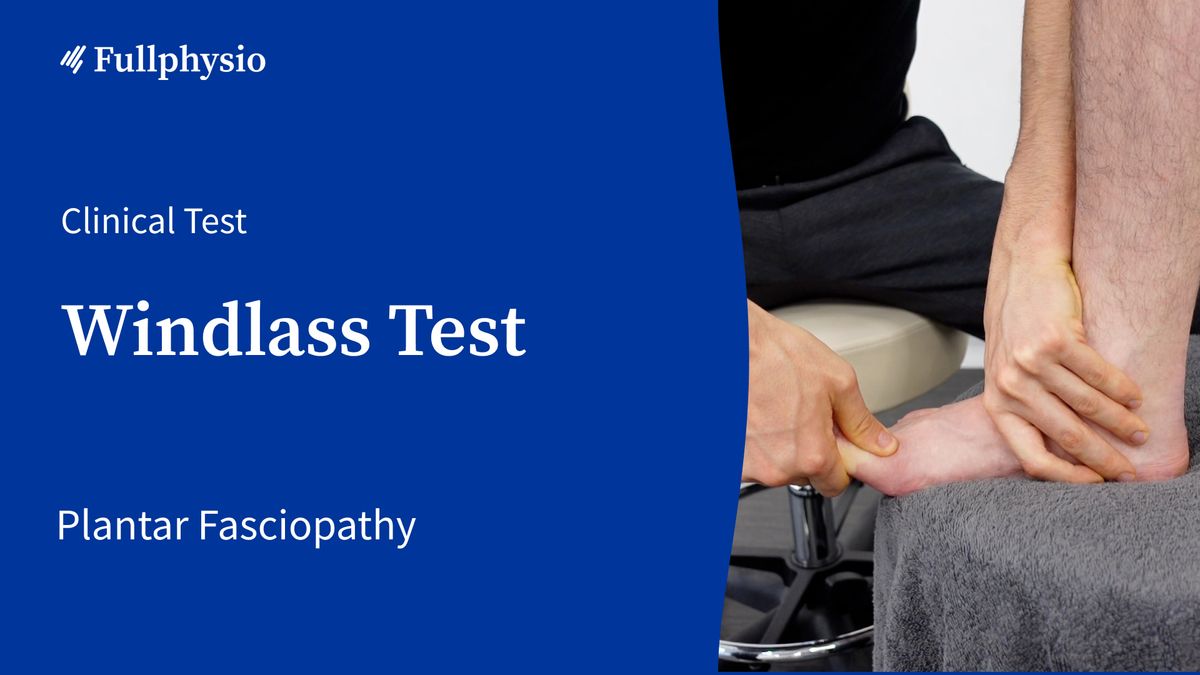
An objective and specific test for diagnosing plantar fasciopathy is the Windlass Test (Petraglia et al., 2017; Tseng et al., 2023).
Video of the Test
Execution
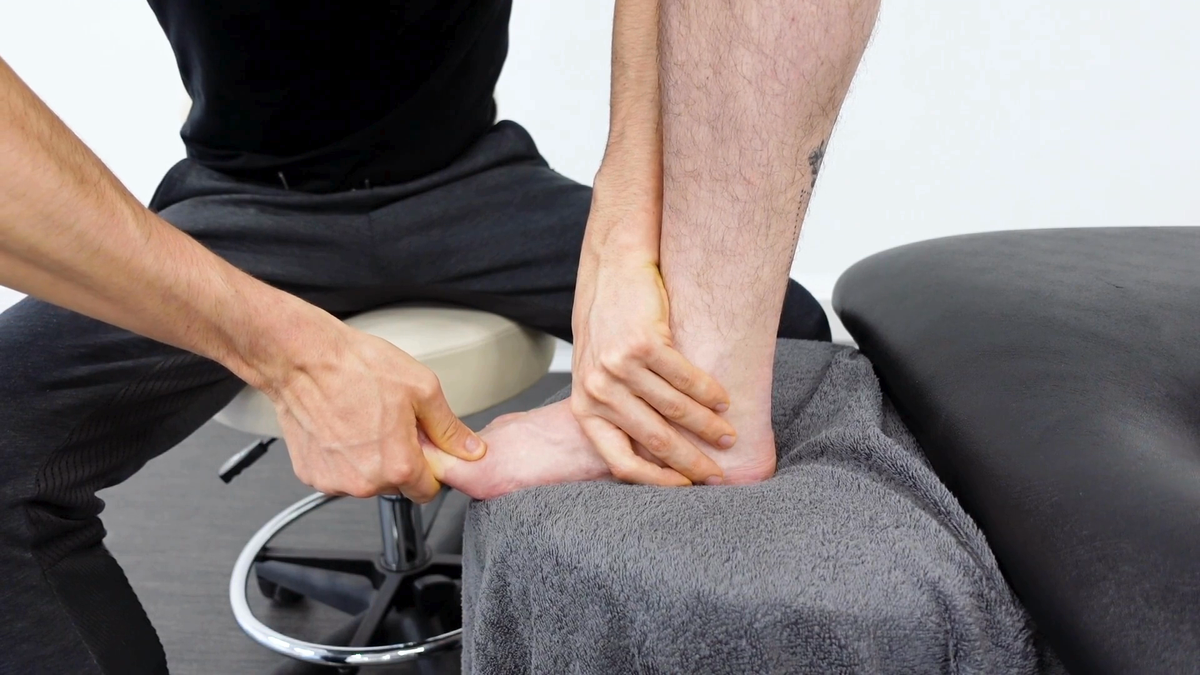
To perform the Windlass Test, the patient stands on a stool or a similar surface so that the metatarsal heads of the affected foot are supported.
The therapist grasps the proximal segment of the hallux and dorsiflexes the metatarsophalangeal joint to end range or until the subject feels pain. The test is positive if the patient feels pain at the insertion of the fascia at the head of the first metatarsal.
Clinical Value
In their 2003 study, De Garceau et al. found that this test had a specificity of 100% and a sensitivity of 31.8%. This test therefore appears to be useful for confirming the presence of this condition when the test is positive (De Garceau et al., 2003; Tseng et al., 2023).
Bibliography
Buchbinder, Rachelle. « Clinical Practice. Plantar Fasciitis ». The New England Journal of Medicine 350, nᵒ 21 (20 mai 2004): 2159‑66.
Crawford, Fay, et Colin E. Thomson. « Interventions for Treating Plantar Heel Pain ». Cochrane Database of Systematic Reviews, nᵒ 3 (2003).
De Garceau, Denise, Danielle Dean, Susan Mais Requejo, et David B. Thordarson. « The Association between Diagnosis of Plantar Fasciitis and Windlass Test Results ». Foot & Ankle International 24, no 3 (mars 2003): 251‑55.
Hossain, Munier, et Nilesh Makwana. « “Not Plantar Fasciitis”: The Differential Diagnosis and Management of Heel Pain Syndrome ». Orthopaedics and Trauma 25, nᵒ 3 (1 juin 2011): 198‑206.
Hunt, Gary C, Tom Sneed, Herb Hamann, et Sheldon Chisam. « Biomechanical and Histiological Considerations for Development of Plantar Fasciitis and Evaluation of Arch Taping as a Treatment Option to Control Associated Plantar Heel Pain: A Single-Subject Design ». The Foot 14, nᵒ 3 (1 septembre 2004): 147‑53.
Kakouris, Nicolas, Numan Yener, et Daniel T. P. Fong. « A Systematic Review of Running-Related Musculoskeletal Injuries in Runners ». Journal of Sport and Health Science, 20 avril 2021.
Lemont, Harvey, Krista M. Ammirati, et Nsima Usen. « Plantar Fasciitis: A Degenerative Process (Fasciosis) without Inflammation ». Journal of the American Podiatric Medical Association 93, nᵒ 3 (juin 2003): 234‑37.
Lopes, Alexandre Dias, Luiz Carlos Hespanhol Júnior, Simon S. Yeung, et Leonardo Oliveira Pena Costa. « What Are the Main Running-Related Musculoskeletal Injuries? A Systematic Review ». Sports Medicine (Auckland, N.Z.) 42, nᵒ 10 (1 octobre 2012): 891‑905.
McPoil, Thomas G., Robroy L. Martin, Mark W. Cornwall, Dane K. Wukich, James J. Irrgang, et Joseph J. Godges. « Heel Pain--Plantar Fasciitis: Clinical Practice Guildelines Linked to the International Classification of Function, Disability, and Health from the Orthopaedic Section of the American Physical Therapy Association ». The Journal of Orthopaedic and Sports Physical Therapy 38, nᵒ 4 (avril 2008): A1‑18.
Petraglia, F., Ramazzina, I., & Costantino, C. (2017). Plantar fasciitis in athletes : Diagnostic and treatment strategies. A systematic review. Muscles, Ligaments and Tendons Journal, 7(1), 107.
Puttaswamaiah, Ravindra, et Prakash Chandran. « Degenerative Plantar Fasciitis: A Review of Current Concepts ». The Foot 17, nᵒ 1 (1 mars 2007): 3‑9.
Tseng, W.-C., Chen, Y.-C., Lee, T.-M., & Chen, W.-S. (2023). Plantar Fasciitis : An Updated Review. Journal of Medical Ultrasound, 31(4), 268.