Resources
Stay informed
Laslett Cluster
Contents
Test protocol
Context
The identification of subgroups of patients with low back pain for prognostic, diagnostic, and treatment purposes has been a topic of research for many years (Petersen et al., 2017). The role of the sacroiliac joint in low back pain and lower limb pain has been the subject of much debate. It appears that 10 to 25% of patients with persistent mechanical low back pain below L5 experience pain secondary to sacroiliac joint pathology (Simopoulos et al., 2012).
Since pain originating from the sacroiliac joint is difficult to distinguish from other forms of low back pain based on history alone, various symptom-provocation tests have been proposed.
Individually, they have a low predictive value, but a battery of combined tests can help establish a diagnosis (Laslett et al., 2005; Vanelderen et al., 2010; Han et al., 2023). This is the case, for example, with the Laslett Cluster.
As a reminder, a cluster is a set of specialized tests designed to aid clinical decision-making by improving the accuracy of our diagnosis.
When we see a patient in the office who complains of lower back pain, it is important to be able to correctly identify the joint responsible for the pain.
Laslett had originally planned six sacroiliac joint provocation tests. Ultimately, he eliminated the left and right Gaenslen Tests, proposing a set of four tests instead.
Video of the Test

Execution
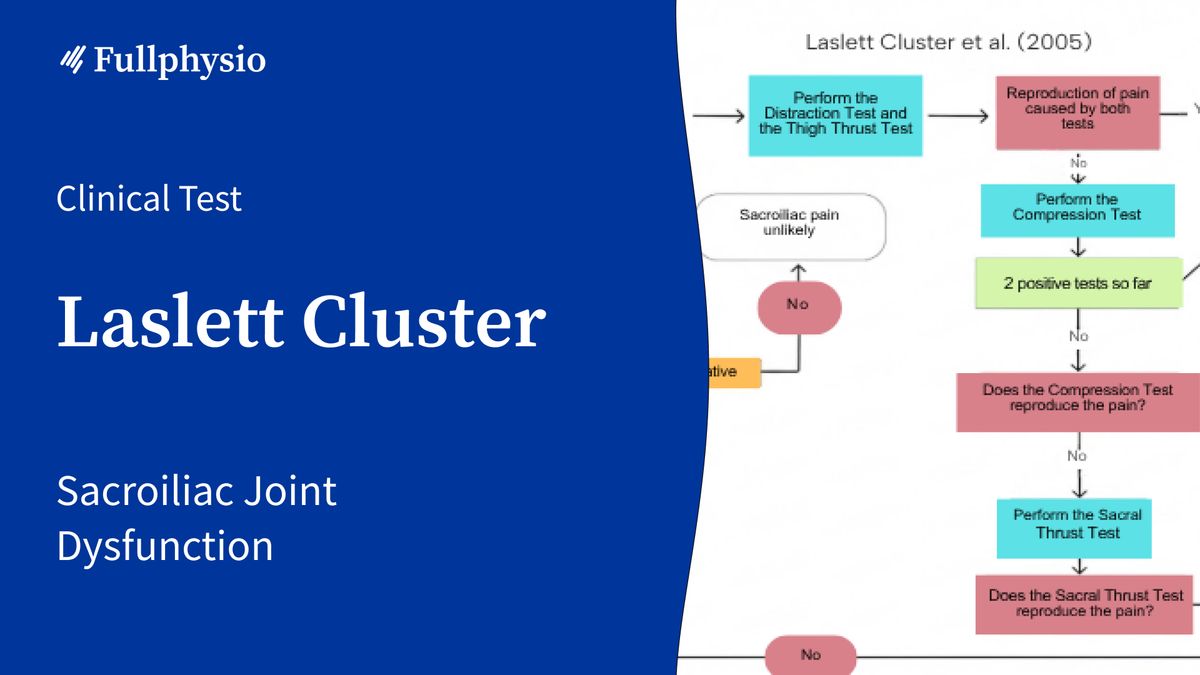
The first test is the Distraction Test: the patient lies on their back. The physical therapist stands on the affected side, directly behind the patient’s pelvis, and places both hands on the inner sides of the anterior superior iliac spine. They apply three to six pushes at a moderate pace while gradually increasing the pressure. The goal of this pressure is to open the iliac wings and compress the sacroiliac joint. The test is positive if the patient feels a familiar pain in the lower back.
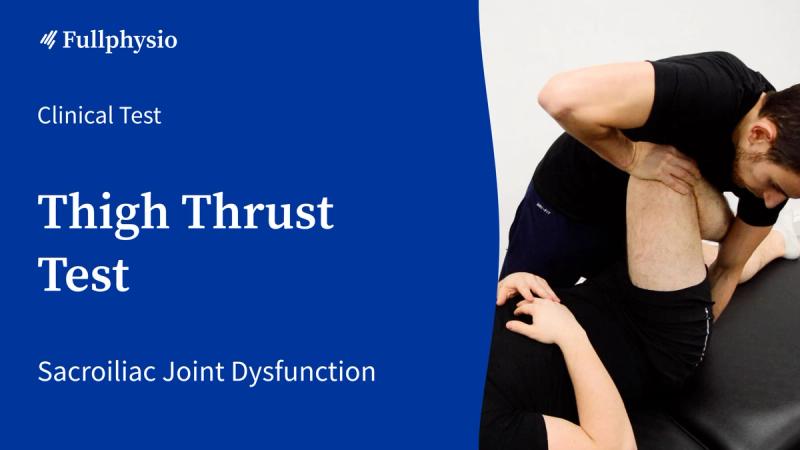
The second test is the Thigh Push Test: the patient lies supine, and the therapist stands on the patient’s healthy side. The therapist grasps the affected leg, then brings the hip to 90° of flexion and slight adduction. While tilting the patient toward them, the physical therapist places one hand under the sacrum, then returns the patient to the starting position. The physical therapist then applies pressure along the axis of the patient’s femur. They perform three to six rapid pushes while gradually increasing the pressure. This pressure creates shear stress within the sacroiliac joint. The test is positive if the patient’s symptoms are reproduced.
The third test is a compression test: the patient lies on their symptomatic side, with the hips flexed at 45° and the knees flexed at 90°. The physical therapist stands behind the patient and applies pressure with both hands to the patient’s iliac wing. The physical therapist performs three to six pushes at a moderate speed toward the opposite iliac wing and gradually increases the pressure. The test is positive if it reproduces the patient’s pain over the sacroiliac joint.
The fourth test is the Sacral Thrust Test: to perform this test, the patient lies prone. The therapist places the palm of their hand at the S2 level and performs three to six rapid vertical thrusts, gradually increasing the pressure. As with the other tests, it is positive if it reproduces pain at the sacroiliac joint.
If two or more tests are negative, we take little risk in ruling out sacroiliac pain.
Clinical Value
It has been agreed that the four tests should be conducted, stopping once two of them are positive. If two of the four tests are positive, the sensitivity would be 88% and the specificity 78%.
However, in 2021, Saueressig et al. evaluated the diagnostic accuracy of sacroiliac joint provocation tests—including the Gaenslen Test—in their systematic review and meta-analysis. The results showed that a cluster of tests could not be used to confirm sacroiliac joint involvement but, on the contrary, could be used to rule it out. The results of this study are consistent with those of the systematic review by Han and colleagues in 2023.
Bibliography
Han, C. S., Hancock, M. J., Sharma, S., Sharma, S., Harris, I. A., Cohen, S. P., Magnussen, J., Maher, C. G., & Traeger, A. C. (2023). Low back pain of disc, sacroiliac joint, or facet joint origin : A diagnostic accuracy systematic review. eClinicalMedicine, 59, 101960.
Laslett, M., Aprill, C. N., McDonald, B., & Young, S. B. (2005). Diagnosis of Sacroiliac Joint Pain: Validity of individual provocation tests and composites of tests. Manual Therapy, 10(3), 207–218. doi:10.1016/j.math.2005.01.003
Petersen, Tom, Mark Laslett, et Carsten Juhl. « Clinical classification in low back pain: best-evidence diagnostic rules based on systematic reviews ». BMC Musculoskeletal Disorders 18 (12 mai 2017): 188.
Saueressig, Tobias, Patrick J. Owen, Frank Diemer, Jochen Zebisch, et Daniel L. Belavy. « Diagnostic Accuracy of Clusters of Pain Provocation Tests for Detecting Sacroiliac Joint Pain: Systematic Review With Meta-Analysis ». The Journal of Orthopaedic and Sports Physical Therapy 51, no 9 (septembre 2021): 422‑31.
Simopoulos, Thomas T., Laxmaiah Manchikanti, Vijay Singh, Sanjeeva Gupta, Haroon Hameed, Sudhir Diwan, et Steven P. Cohen. « A Systematic Evaluation of Prevalence and Diagnostic Accuracy of Sacroiliac Joint Interventions ». Pain Physician 15, no 3 (juin 2012): E305-344.
Vanelderen, Pascal, Karolina Szadek, Steven P. Cohen, Jan De Witte, Arno Lataster, Jacob Patijn, Nagy Mekhail, Maarten van Kleef, et Jan Van Zundert. « 13. Sacroiliac Joint Pain ». Pain Practice: The Official Journal of World Institute of Pain 10, no 5 (octobre 2010): 470‑78.