Resources
Stay informed
Passive Lumbar Extension Test
Contents
Test protocol
Context
It has been demonstrated that identifying different subgroups among patients with low back pain may help to guide management. One of these subgroups is lumbar segmental instability. Its diagnosis relies primarily on a cluster of subjective and objective findings, which you will find in the Low Back Pain Module.
Nevertheless, clinicians have used several clinical tests to detect spinal instability and the ability of the muscles to stabilize the lumbar spine, including the Passive Lumbar Extension Test.
Video of the Test
Execution
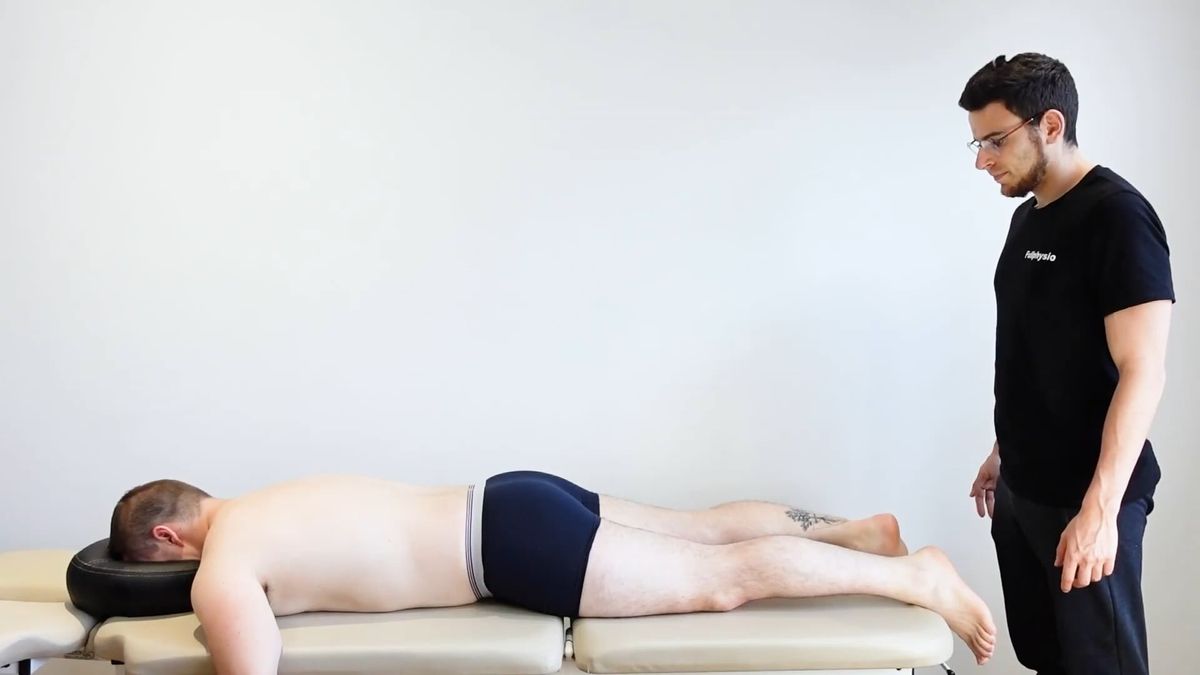
To perform this test, the patient lies prone on the table. The therapist stands at the patient’s feet, grasps the ankles to raise them approximately 30 cm above the table, then gently pulls them to keep the knees extended. The test is positive if the patient reports severe pain in the lumbar region, expresses a sensation that the lower back is “detaching,” or if the pain disappears when the lower limbs are returned to the initial position.
Clinical Value
Regarding the clinical value of this test, Kasai and colleagues proposed this test in 2006 with the aim of diagnosing structural lumbar instability. The authors reported a sensitivity of 84% and a specificity of 90%, supporting the usefulness of this test in clinical practice.
In their 2015 study, Ferrari et al. found that the Passive Lumbar Extension Test was the most accurate and provided the most information, with high sensitivity and specificity (Ferrari et al., 2015; Wang and Huang, 2022).
However, in 2019, Rathod et al. evaluated the clinical value of this test using radiography as the reference standard for diagnosing structural instability of the lumbar spine. The authors reported a sensitivity of 68.89% and a specificity of 20% for the Passive Lumbar Extension Test (Rathod et al., 2019; Wang and Huang, 2022).
It is important to note that, despite negative imaging findings, some authors describe so-called clinical or functional instability, in which no structural defects of the lumbar spine and no excessive translation or rotation have been demonstrated.
Bibliography
Ferrari, Silvano, Tiziana Manni, Francesca Bonetti, Jorge Hugo Villafañe, et Carla Vanti. « A literature review of clinical tests for lumbar instability in low back pain: validity and applicability in clinical practice ». *Chiropractic & Manual Therapies* 23 (8 avril 2015).
Kasai, Yuichi, Koichiro Morishita, Eiji Kawakita, Tetsushi Kondo, et Atsumasa Uchida. « A New Evaluation Method for Lumbar Spinal Instability: Passive Lumbar Extension Test ». *Physical Therapy* 86, no 12 (décembre 2006): 1661‑67.
Hodges, Paul W., et G. Lorimer Moseley. « Pain and Motor Control of the Lumbopelvic Region: Effect and Possible Mechanisms ». *Journal of Electromyography and Kinesiology: Official Journal of the International Society of Electrophysiological Kinesiology* 13, no 4 (août 2003): 361‑70.
Macedo, Luciana G., Jane Latimer, Chris G. Maher, Paul W. Hodges, Michael Nicholas, Lois Tonkin, James H. McAuley, et Ryan Stafford. « Motor Control or Graded Activity Exercises for Chronic Low Back Pain? A Randomised Controlled Trial ». *BMC Musculoskeletal Disorders* 9 (5 mai 2008): 65.
Rathod, Ashok Keshav, Bipul Kumar Garg, et Varun Mukesh Sahetia. « Lumbar Rocking Test: A New Clinical Test for Predicting Lumbar Instability ». *Journal of Craniovertebral Junction & Spine* 10, no 1 (mars 2019): 33‑38.
Wang, Y., & Huang, K. (2022). Research progress of diagnosing methodology for lumbar segmental instability. Medicine, 101(1), e28534.